
Things to do in Bukhara
Explore top experiences
Top 10 attractions in Bukhara


Ark of Bukhara
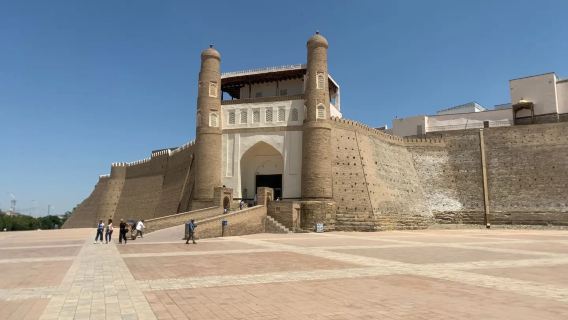
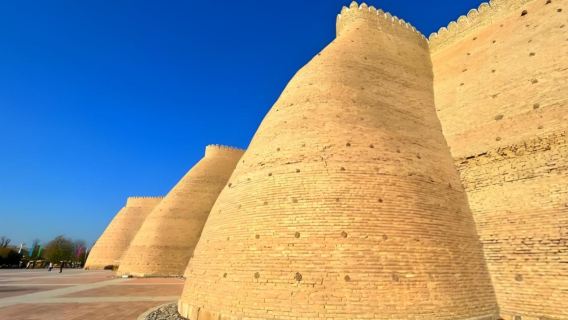
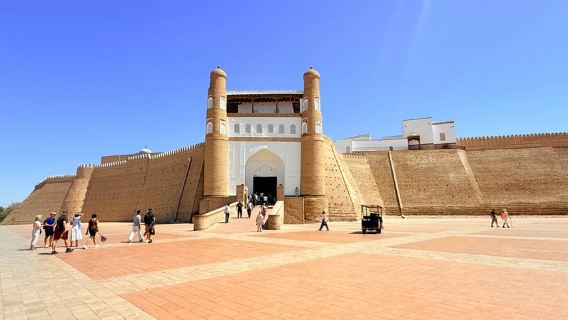
Ark of Bukhara is a massive royal citadel built of rammed earth. It covers an area of nearly 4 hectares and is surrounded by high walls. Most of the existing structures were built after the 17th century and have been converted into several themed museums, including archaeology, history, numismatics, nature, and manuscripts. The archaeology and history museums house artifacts unearthed from ancient city ruins such as Varakhsha and Paykend, and the former audience hall and coronation hall are also open to visitors. Walking in from the ramp between the two entrance towers, the dim corridor beneath your feet was once the vital passage to the citadel, with storerooms and prison cells on both sides. Many tourists walk through in a hurry, but it is actually worth slowing down to take a closer look.Bukhara · 1.7km from downtown

Sitora-i-Moh-i Khosa palace
Sitora-i-Moh-i Khosa palace is the country residence of the Emir of Bukhara. The complex is divided into old and new sections: the old palace follows traditional Eastern styles, while the new palace was built in the early 20th century during the reign of the last Emir, Alim Khan. It was constructed by renowned Bukhara craftsmen and Russian engineers, blending European-style facades with local craftsmanship such as carved wooden columns and plaster ornaments. The interior remains traditionally divided into male guest areas and female quarters. Today, it serves as a museum of decorative and applied arts. The main building displays 19th- and 20th-century court furniture, porcelain from China and Japan, Russian court art, and jewelry and gold-thread embroidery crafted by Bukhara artisans; the octagonal pavilion exhibits clothing, belts, and footwear worn by Bukhara townspeople from the late 19th to the early 20th century; another exhibition area features traditional embroidered wall hangings known as "Suzani," prayer rugs, other folk textiles, and household utensils, and it also recreates the indoor living scenes of urban Bukhara families.Bukhara · 5.6km from downtown

Chor Minor Monument
Chor Minor Monument is hidden deep within the alleys of the old town of Bukhara, Uzbekistan. It was originally the gatehouse of a madrasa. The buildings behind it have long been demolished, leaving only this uniquely shaped entrance structure today. The four towers are the signature view here: the earthen-brick towers support turquoise-tiled domes, standing out remarkably against the city's earthy yellow tones, and the decorative patterns on each of the four towers are unique. These towers are not actually true towers. Three were used for storage, and only one contains a staircase. The domed prayer hall in the center of the gatehouse retains a typical Central Asian mosque layout, with impressive acoustics under the dome.Bukhara · 1.1km from downtown

Kalan Minaret
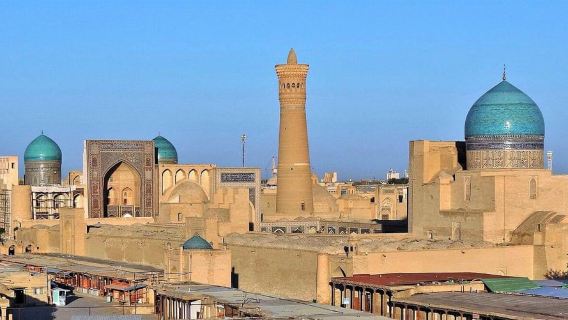
The Kayan Minaret is a well-known architectural monument in Bukhara. It was built in 1127 and is 46.5 meters high. It is located next to the Grand Mosque in the center of the old district of Bukhara. It is higher than the entire city of Bukhara and its entrance can be seen a few kilometers from Bukhara. There are many neatly structured buildings around the minaret. The minaret was originally used to call people to pray loudly and was built of burnt bricks. The foundation has a depth of 16 meters and a straight length of 9 meters. There are 16 arched light-transmitting windows at the top of the tower, which are decorated with stalactite-shaped eaves. At the top there is a long and narrow arched cloister leading to a ladder. The cloister is composed of 16 arches connected to the main building through light. The body of the minaret is covered with decorative patterns made of bricks. The building is divided into 14 decorative bands, each of which has clear patterns for decoration, and all patterns are different.Bukhara · 1.3km from downtown

Ismail Samani Mausoleum
Located in the Samani Park, the mausoleum was completed in 905. Built for Ismail Samani, his father and grandson, the mausoleum is made of terracotta bricks that have undergone a complex firing process - during the day, these bricks gradually change their "character" due to the movement of light and shadows - covering the wall by nearly 2 meters. Thanks to this wall, the mausoleum (except for the dome with a pointed roof) has not needed repair since the 11th century.Bukhara · 2.2km from downtown

Nodir Devonbegi Madrasah
Nodir Devonbegi Madrasah is located in the heart of the old town of Bukhara, Uzbekistan, and is an important part of the Lyabi-Hauz architectural complex. Built in the early 17th century, around 1622–1623, this madrasah was commissioned by Nadir Divanbegi, a high-ranking official of the time. It was not originally intended for education but served as a caravanserai for merchants and travelers, and was later converted into a religious education institution at the request of the ruler. The building features a closed courtyard layout, with small two-story rooms around the perimeter, primarily used as living quarters for scholars and students. Due to its conversion, it lacks the large lecture halls commonly found in traditional madrasahs, making it more compact and practical. The most striking feature is the decoration of the main facade, where colorful tile mosaics depict motifs such as mythical birds and deer, which is rare in Islamic architecture and gives the building a distinctive artistic identity.Bukhara · 805m from downtown

Ulugbek Madrasah
Ulugbek Madrasah located in Bukhara, Uzbekistan, is an Islamic institution of higher learning built in the early 15th century. It is one of the oldest surviving madrasa in Central Asia and possesses significant historical and architectural value. This Islamic religious school features beautifully tiled exteriors, fluted domes, and stained-glass windows. Several ancient tombs are also preserved inside. It is a monument to the golden age of Central Asian architecture, and its architectural style was later widely adopted in the construction of Islamic schools (madrasa) in other Central Asian cities. Today, Ulugbek Madrasah, an important cultural heritage site and museum space, is open to the public. It features exhibits on the history of Bukhara's restoration, serving as a window into Central Asian Islamic architectural art and a key point for understanding Uzbekistan's academic traditions and urban history.Bukhara · 1.3km from downtown

Lyabi Khause Square
Bukhara · 809m from downtown

Chashmai Ayub Mausoleum
Bukhara · 2.2km from downtown

Zindan
Bukhara · 1.6km from downtown
Experiences you can't miss in Bukhara
Featured Day tours in Bukhara
View all Day tours
Free cancellation
Instant confirmation
Book now for tomorrow
From₹ 7,596.37
From₹ 53,631.15
Book now for tomorrow
From₹ 9,970.23
Free cancellation
Instant confirmation
Book now for tomorrow
From₹ 7,596.37
5.0/5
· 44 reviewsFree cancellation
Book now for tomorrow
44 consecutive positive reviews
5% off
Limited-time sale
From₹ 1,721.40₹ 1,812.01
4.9/5
· 74 reviewsFree cancellation
Book now for tomorrow
60 consecutive positive reviews
5% off
Limited-time sale
From₹ 2,094.04₹ 2,204.26

5.0/5
· 29 reviewsFree cancellation
29 consecutive positive reviews
From₹ 12,154.19
Free things to do in Bukhara
Ark of Bukhara
Bukhara · 1.7km from downtownSitora-i-Moh-i Khosa palace
Bukhara · 5.6km from downtownChor Minor Monument
Bukhara · 1.1km from downtownKalan Minaret
Bukhara · 1.3km from downtownIsmail Samani Mausoleum
Bukhara · 2.2km from downtownNodir Devonbegi Madrasah
Bukhara · 805m from downtownBook now for tomorrowUlugbek Madrasah
Bukhara · 1.3km from downtownLyabi Khause Square
Bukhara · 809m from downtownChashmai Ayub Mausoleum
Bukhara · 2.2km from downtownZindan
Bukhara · 1.6km from downtown
More ways to travel from Bukhara
Private Tours in Bukhara
View More Private Tours in Bukhara

Group Tours in Bukhara
View More Group Tours in Bukhara


What travellers say about Bukhara

benx613530 July 2026
5.0
The Ark of Bukhara is one of the most unmissable historical sites in the city. In the hot days of the summer, this impressive structure is at the peak of its magnificence, emanating an aura from the ancient days when it was a prominent fortress, equipped with cannons, high walls and observation towers that survived the test of time until this day. The interiors of the Ark are accessible with an entrance fee, while the exteriors of the site have good photo and sightseeing spots free of charge.
Ark of Bukhara

Alison’s Silk Road Travels24 July 2026
5.0
I visited Sitora-I-Moh-I today as it was not far from my hotel. I’m really glad I visited what a stunning Palace! If you are interested in Architecture and applied arts then you will by amazed at the artefacts in the Palace. The walls are hand painted and tiled in the most beautiful designs. There is a very comprehensive costume museum inside the palace with a variety of coats, books, shoes, belts and hats from the ladies of the Harem and the Emir Alim Khan himself! I didn’t expect such a large collection of artefacts of such supreme museum quality. The tiles and the embroideries were exquisite. The surroundings were beautiful and restoration work was going on during my visit so I was not able to see some of the Palace. I thought the entry fee of 60000 was a real bargain for the Quality of the collection. The Palace is in need of restoration as some of its interiors and exteriors are needing to be painted. I hope that visits will contribute to the funds necessary to update the Palace so more people can enjoy it.
Sitora-i-Moh-i Khosa palace

Pamelina10 September 2026
4.0
An interesting place to see in Bukhara, with very unique architecture. You can pay to go up, but in my opinion it's not worth it. It's prettier from the outside.
Chor Minor Monument

泡泡霸王龙26 December 2023
5.0
It is rare that a 1100-year-old building has been well maintained and preserved. Stone buildings are reliable. The tricycles soliciting customers beside the square are exactly the same as those in China. The overall price here is not expensive, so you can spend money with confidence.
Kalan Minaret

一直在路上的猫27 September 2026
4.0
Ismail Samani Mausoleum
(Samanian Royal Mausoleum, Ismail Samani Mausoleum)
It is the oldest and best-preserved Islamic mausoleum in Central Asia and a World Heritage Site.
Built in the 9th–10th centuries AD (completed around 905 AD), it is the final resting place of Ismail Samani, the founder of the Samanid dynasty, along with his father and grandson—a total of three members of the royal family.
• The entire structure is built solely of fired brick, without glazed tiles or painted decorations. It relies on over 20 different bricklaying techniques to create three-dimensional geometric patterns. The interplay of light and shadow on the brickwork changes with the angle of sunlight, representing the pinnacle of early Islamic brick architecture.
• Design: A cubic base with a massive central hemispherical dome, flanked by four smaller domes at the corners; perfectly symmetrical on all four sides, with no distinct front or back. The cube represents the earth, and the dome represents the heavens, blending the Zoroastrian concept of a round heaven and a square earth with Islamic architectural aesthetics.
• There is a story: During the Mongol westward expansion, the locals voluntarily covered the entire cemetery with earth, thus escaping destruction by Genghis Khan's army. It wasn't until archaeological excavations during the Soviet era that it saw the light of day again; it is the only surviving structure from the Samanid dynasty.
• Location: Within Bukhara City Park; legend says that walking around the tomb three times will bring good luck. Many books about the dynasty are sold nearby.
The Story of the Samanid Dynasty (819–999 AD)
The Samanid dynasty was a period of Persian cultural revival, which the Tajiks consider their golden age.
1. Origins
The ancestor, Saman al-Huda, was originally a Persian Zoroastrian nobleman who later converted to Islam. To reward his family, the Abbasid Caliph granted several cities in Central Asia to Saman's four grandsons, including Bukhara, Samarkand, Fergana, and Tashkent, all within his sphere of influence.
2. The Reign of Timur: Ismail Samani
He established Bukhara as the capital, unified Transoxiana (including Uzbekistan and Tajikistan), and expanded westward to Khorasan, Iran.
• A powerful nation flourished, and Silk Road trade prospered;
• He vigorously promoted Persian culture, bringing Persian back into the mainstream of Central Asia, leading to the translation of numerous classic texts and a boom in literature;
• He encouraged science, astronomy, and medicine, ushering in a golden age of culture in Central Asia.
In short: Before Timur, the Samanid dynasty was the dominant power in Central Asia. Samarkand was then part of Samanid territory, but the capital was Bukhara.
3. The End of the Dynasty
In 999, the Karakhanid dynasty from the east invaded, captured Bukhara, and the Samanid dynasty collapsed.
After the fall of the Samanid dynasty, power in Central Asia changed hands several times before Timur rose to power centuries later, establishing his capital in Samarkand.
Ismail Samani Mausoleum

可可喵小众文化怪谈录25 February 2026
5.0
Bukhara features a rare Khwarez-style conical double-dome design. Legend has it that during a severe drought, Job struck the ground with his staff, and springs of water gushed forth, saving the entire city. Inside is a water management museum, with historical records on the walls detailing the gradual disappearance of the Aral Sea. Once the world's fourth largest lake, the Aral Sea suffered a dramatic decline in water flow from two rivers after the 1960s due to the Soviet Union's large-scale cotton planting and irrigation projects. This led to a continuous drop in the sea level and shrinkage of the lake. In 1987, the Aral Sea split into northern and southern parts. By 2014, the eastern part of the southern Aral Sea had completely dried up, turning the lakebed into a desert and triggering serious environmental and social problems such as salt dust storms, ecological degradation, and the collapse of fisheries. The disappearance of the Aral Sea is a major ecological disaster caused by excessive water use and a classic lesson in the irrational development of water resources.
Chashmai Ayub Mausoleum


