Daming

Things to do in Daming

Search attractions or local attractions & tours
Search

Explore top experiences

Top 10 attractions in Daming

View all Attractions
Daming Stone Carving Museum

Daming Stone Carving Museum

3.5
4.8/5
42 reviews

The Daming County Stone Carving Museum exhibition takes the cultural relics of Handan stone carvings as the theme, and uses physical objects, pictures, charts, rubbings, texts, images, etc. The exhibition is divided into 4 parts: statues of the Northern Dynasty, statues of the Sui and Tang Dynasties, statues of the Five Dynasties and Song Dynasty, and carved rubbings of the Northern Dynasties. Among them, the white marble statue in Yecheng and the red sandstone statue in Changle Temple are the most exquisite. The north gallery of the museum mainly displays 25 stele inscriptions from the Tang Dynasty to before the founding of New China, 11 stele inscriptions and 38 epitaphs at the north end of the east gallery, and more than 60 steles with famous allusions, historical materials and explanations written by modern calligraphers of famous books in the west gallery. The "Five Rites Monument" is set up in the museum, and more than 20 pieces of inscriptions and stone carvings are scattered on the ground, which are of ornamental value. Handan stone carving art has a long history. As early as 8,000 years ago, the ancestors of Cishan created original stone carving art forms such as stone grinding discs and stone grinding rods. In Handan, there are still precious stone carvings of the Han Dynasty "Qunchen Shangtan" and "Zhao Guoyiyang South Boundary". Left and south Xiangtang Grottoes and many single stone statues, created the "Northern Qi style" of Buddhist statue art, which had a profound impact on the statue art after the Sui and Tang Dynasties.

Daming · 4km from downtown
Daming Ancient City

Daming Ancient City

3.5
5.0/5
10 reviews

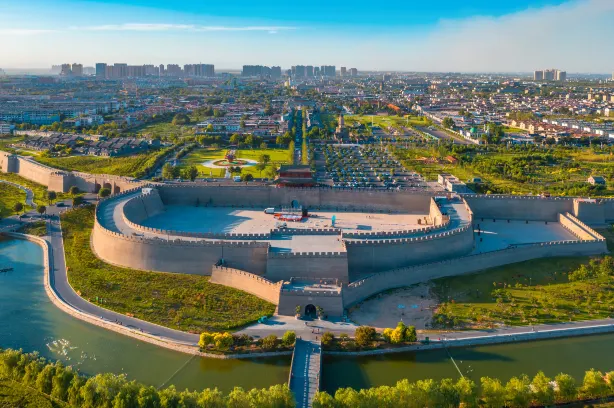
Daming County is located in the southeast of Hebei Province, at the junction of Hebei, Shandong, and Henan provinces. Covering an area of 1,053 sq km with a registered population of approximately 930,000, it is one of the first pilot counties for expanded administrative authority in Hebei and a provincial-level historical and cultural city. The county served as a national capital twice and a secondary capital seven times in history, earning the title "Northern Capital Daming Prefecture." With over 2,200 years of historical heritage, it stands as a significant bearer of Central Plains culture. Today, Daming County is renowned as the "Flour Capital of China," "Hometown of Chinese Peanuts," and "Hometown of Chinese Stone-Milled Sesame Oil," blending ancient charm with modern industrial vitality. The Daming Ancient City, situated in Daming County, Handan City, Hebei Province, was initially built in 1401 during the Ming Dynasty after floods from the Zhang and Wei rivers submerged the old Song Dynasty city. The square-shaped city spans nine li in perimeter, featuring stone-based walls topped with blue bricks and four gates named "Tiren, Chongli, Leyi, and Duanzhi." Encircled by a connected moat, it formed a military defense system described as "three towers standing tall and artillery platforms lining up," acclaimed as a "unique wonder across Hebei, Shandong, and Henan." During the Qing Dynasty, it served as the first provincial capital of Zhili Province for 70 years, housing 72 government offices within its walls.

Daming · 388m from downtown
Mount Taishan
2026 Asia 100 - Best Things to Do

Mount Taishan

9
4.7/5
62.9k reviews

Mount Taishan is centered around Mount Taishan, the first of the Five Great Mountains, with steep and towering peaks, and the views of sunrise and sunset from the summit are breathtaking. Sea of clouds often appear among the mountains, and in winter there are spectacular rime ice views. In addition to natural scenery, the mountain also has numerous historical sites, stone inscriptions, religious temples, and other cultural views, with cliff inscriptions and steles scattered throughout the mountain, which is a major feature of Mount Taishan. Mount Taishan has its own highlights in each of the four seasons: in spring, peach and pear blossoms bloom across the mountains; in summer, the mountaintop is lush green and cool, making it a great summer retreat; in fall, the leaves are a mix of red and yellow, dyeing the layered forests in brilliant colors. There are multiple routes to the summit of Mount Taishan. The hiking trail at the Hongmen entrance is the traditional route opened during Emperor Qin Shi Huang's Fengshan ceremony, consisting mainly of stone steps. Walking from Hongmen to Zhongtianmen, you will pass by numerous attractions along the way, including Wanxian Tower, Doumu Palace, Huima Ridge, and Hutiange. This area is also where stone inscriptions are concentrated. After reaching Zhongtianmen, you can take a cable car or walk to Nantianmen and the summit area, where you can see attractions such as Eighteen Bends, Shengxian Archway, Duisong Mountain, Chaoyang Cave, and Wudafu Pines. The Tianwaicun route is a road leading from Tianwaicun to Zhongtianmen, accessible by tour bus, passing by Heilong Pool, Fanzhi Cliff, and Feng Yuxiang's Tomb. After reaching Zhongtianmen, it merges with the latter half of the Hongmen route. Travelers who prefer not to hike can choose this route. The Tianzhufeng route is relatively steep with few visitors, and is a hiking route often taken by outdoor enthusiasts. It features beautiful mountain scenery, including attractions such as Liyu Back, and at the starting point there is also the large-scale live performance "Chinese Mount Taishan: Grand Ceremony of Fengshan." The Taohuayu route is mostly chosen by travelers when descending the mountain. From Tianjie at the summit, take the ropeway to the mountainside, then transfer to a tour bus down to Taohuayu at the foot of the mountain. Along the way, you can enjoy the Colorful Stone Stream scenic area, where the colorful stone patterns at the bottom of the stream are quite magical. Dongyudao is also a walking hiking route, with attractions such as Qingyang Hall, Hanque Gate, and Dongtianmen along the way. Each route ultimately leads to the Daiding tourist area at the summit. Daiding features the main peak of Mount Taishan, Jade Emperor Peak, the Tianjie Scenic Area, as well as attractions such as Sun Viewing Peak, Daguan Peak, Zhanlu Terrace, Bixia Temple, and Confucius Temple. On clear days at the summit, you can gaze at the Yellow River in the distance and admire the wonder of the "Golden Belt of the Yellow River." The Houshiwu area is rich in varied pines and rocks, and there is a cableway leading to the North Heavenly Gate. Many visitors who want to watch the sunrise choose to climb Mount Taishan at night, usually setting off from the Hongmen route, and it is advisable to depart around 11 pm. This route is well lit at night, and a hike of about seven to eight hours will allow you to reach Sun Viewing Peak or Jade Emperor Peak at the summit before sunrise, which are ideal spots for watching the sunrise.

China · Tai'an
Millennium City Park
2026 Asia 100 - Night Attractions

Millennium City Park

8.8
4.6/5
29k reviews

Millennium City Park is located by the shores of Longting Lake in Kaifeng. It is a large-scale historical and cultural theme park of the Song Dynasty, recreated one-to-one based on the famous painting Along the River During the Qingming Festival by Song Dynasty painter Zhang Zeduan. The park is divided into two sections by the Shuangting Bridge: the South Garden recreates the bustling street life of the Bianjing city, with taverns, eateries, teahouses, and pharmacies lined up along the streets; the North Garden is an imperial garden, with waterside halls, the Sifang Courtyard, and other palace buildings standing by the lake. Performers and street vendors in the park mostly wear Song Dynasty costumes, with ancient music lingering and bells and drums sounding, so that after a few steps visitors can easily fall under the illusion of "stepping into a painting in one morning, dreaming back a thousand years in one day." Architecture is the intuitive and tangible highlight here: the Rainbow Bridge spanning the Bian River is a replica of the famous bridge in the painting, shaped like a long rainbow, and standing on the bridge watching the grain boats pass by feels much like being inside the painting; the Fuyun Pavilion towers above all the other pavilions in the garden, with its tiered red towers and golden tiles on all four eaves, inviting one to climb from afar; the Shangshan Gate is rebuilt after the Northern Song dynasty Dongjing city gate, tall and majestic with brilliant painted decorations, making it the most imposing gate tower in the garden; and the Shuixin Xie, Shuangting Bridge, Jiulong Bridge, and other pavilions and waterside structures are scattered among the blue waves. The main attraction of the day is the immersive performances staged throughout the park: "Bao Zheng Inspects the Bian River Grain Transport" unfolds on the water on both sides of the Rainbow Bridge; "Squire Wang Seeks a Son-in-Law" features a decorated tower erected in front of Squire Wang's house where a silk ball is tossed to choose a groom; "Yue Fei Challenges Prince Xiao Liang" raises dust on the Song dynasty parade ground as horses gallop; and folk performances such as cockfighting, stilt walking, and pan drumming are interspersed throughout. To step into the action yourself, head to the Four Directions Courtyard to don traditional costumes and enter the examination cells for a hands-on Song dynasty imperial exam experience; families with children can enjoy carousel rides, roller coasters, and other amusement facilities wrapped in Song dynasty storytelling at the Song Dynasty·Royal Pleasure Ground; and in the entertainment quarters, face-changing, qigong fire-breathing, ancient magic, and other Song dynasty variety acts take turns on stage, with intangible cultural heritage feats ready to break out at any moment right beside you. After nightfall, the park takes on a different face: red lanterns light up one after another, the market streets are brightly illuminated, and it feels like a completely different park from the daytime. The large-scale water-based live performance "The Great Song Dynasty's Eastern Capital: A Dream of Splendor" is staged on the surface of Jinglong Lake. The entire show is woven together from eight classic Song ci poems and the painting Along the River During the Qingming Festival, drawing the audience back to the Northern Song dynasty's Eastern Capital a thousand years ago. The performance runs about 70 minutes, and many visitors deliberately plan their itinerary to stay until the evening to catch this show. Dining in the park is also convenient: the snack street at Dongjing Food Court brings together Kaifeng snacks such as fried liangfen, tongzi chicken, and almond tea, perfect for eating while strolling; if you want to sit down for a proper meal, you can visit the reconstructed Sun Yang Zheng Dian in the park, which was originally one of the seventy-two official restaurants of Bianjing in the Northern Song Dynasty, where you can taste traditional Henan dishes such as soup dumplings and carp with baked noodles.

China · Kaifeng
Guangfu Ancient City
No. 5 of Best Things to Do in Hebei

Guangfu Ancient City

7.6
4.3/5
1.4k reviews

Guangfu Ancient Cityis located in Guangfu town, Yongnian district, Handan city, Hebei province. It is a national 5A-level attraction, a famous historical and cultural town in China, and a wetland park with profound historical heritage. Featuring beautiful northern water town scenery and a long-standing tai chi culture, it is China's unique ancient town, water town and tai chi town. The ancient town. Guangfu ancient town has a history of over 2,600 years, with its city walls stretching 4.5 km in circumference and covering an area of 1.5 square kilometers. The town boasts numerous historical relics, including two national-level protected sites - Guangfu ancient town itself and Hongji bridge, along with over 20 provincial and municipal protected sites such as the former residences of Yang Luchan, Wu Yuxiang and Wu Ruqing. The water town. Guangfu ancient town is located in the Yongnian depression covering an area of 46,000 mu. Surrounding the town walls is a 5 km moat that's 100 m wide, with wetlands beyond it. This "town between two waters" forms a unique view of Guangfu. The depression has perennial water accumulation with lush reeds, thriving fish and shrimp, lotus ponds, and migratory birds, earning it the reputation of "little Jiangnan in the north". The city of taiji. Guangfu ancient town is the birthplace of Yang-style and Wu-style taijiquan, where the founders of the two major schools, Yang Luchan and Wu Yuxiang, were born. It is a renowned hometown of taiji, from which taijiquan spread across China and the world.

Handan · 59.6km from Daming
Jinci Temple Museum
2026 Asia 100 - Family-friendly Attractions

Jinci Temple Museum

8.7
4.8/5
21k reviews

Jinci Temple Museum is located at the foot of Xuanweng Mountain by the banks of the Jin River. It is an ancestral temple built to commemorate Tang Shuyu, the founding feudal lord of the State of Jin, and is also one of the earlier surviving royal sacrificial gardens in China. There is a saying that "you have not truly visited Taiyuan until you have visited Jinci." The ancient buildings in the museum are arranged in sequence along the central axis, among which the Xian Hall, the Flying Bridge over the Fish Pond, and the Hall of the Holy Mother are known as the "three treasures," while the Zhou Cypress, the Never-Aging Spring, and the Song dynasty attendant statues are known as the "three wonders"—these are the core highlights of any visit. The "Three Treasures" are located on the central axis and can be visited together. Xian Hall is the place where sacrificial offerings are placed. The hall is surrounded by railings instead of walls, making it well-ventilated and bright, and its beam structure is simple and lightweight. The Flying Bridge Across Fish Pond is on the west side of Xian Hall. It is a cross-shaped ancient bridge built over a square pond, resembling a modern overpass in form, and this type of bridge structure is extremely rare among surviving ancient buildings. The west end of the bridge connects to Shengmu Hall, the oldest surviving building in the museum. Wooden carved dragons coil around the porch columns in front of the hall, making them relatively early surviving examples of wooden coiled dragons. The hall interior was built using the reduced-column method, creating a rather spacious interior. It houses dozens of Song Dynasty colored sculptures, with the main statue of Shengmu seated in the shrine and the remaining attendants arranged on both sides with varied expressions. One attendant statue is half joyful and half sorrowful, vividly lifelike and moving. With Shengmu Hall as the center, you can also seek out the "Three Wonders." The Zhou Cypress is located on the north side of Shengmu Hall. It is said to have been planted in the Western Zhou Dynasty, and its trunk leans south like a reclining dragon, full of ancient majesty. The Never-Aging Spring is located on the south side of Shengmu Hall and is the main source of the Jin River. The museum also houses the Stele of the Inscription and Preface to Jinci, composed and handwritten by Emperor Taizong of Tang, Li Shimin, whose running-script calligraphy is vigorous and forceful. In the southern part is the Shifang Fengsheng Zen Temple, said to have originally been the villa of the Tang Dynasty general Yuchi Gong. In the Futu Courtyard, the Sarira ShengSheng Pagoda can be climbed for a distant view. The Jinci temple fair has been passed down to the present day and has been included in the national-level intangible cultural heritage list. The Water Mirror Stage, an ancient theater stage in the museum, is an important venue for activities during the temple fair.

China · Taiyuan
Wansuishan Martial Arts City
No. 1 of Family-friendly Attractions in Henan

Wansuishan Martial Arts City

8.6
4.6/5
16.6k reviews

Wansuishan Martial Arts City is located in the northwest of Kaifeng's urban areaWansuishan Martial Arts City, it is a large-scale attraction built with Song Dynasty culture and wuxia culture as its backdrop. Within the attraction, there are quaint and charming Song Dynasty garden streets and alleys, year-round exciting wuxia and period costume performances, as well as a wealth of entertainment facilities, making it a great place for relaxation and entertainment in Kaifeng, Zhengzhou, and surrounding areas. When visiting Wansuishan Martial Arts City, the first thing you will notice is the beautiful scenery of the attraction. Wansuishan Martial Arts City as a whole creates an atmosphere of the Song Dynasty, among which many views are very eye-catching, such as Wansui Temple, which recreates the splendor of a thousand-year-old ancient temple from the Song Dynasty, the Dragon Altar, which embodies the spirit of Buddhism, Confucianism, and Taoism, the relatively well-preserved ancient city wall of Kaifeng in China, and the "Nine Dragons Waterfall," one of the large man-made stream and waterfall groups in China. What is rare is that the attraction also has a very large area of forest and green space, with a quiet environment, and flowers bloom in season, making it very suitable for photography. Afterward, visitors will notice the unique wuxia features within the attraction. Year-round, multiple wuxia-themed performances are staged here, with several themed shows such as "Cross Slope," "Wu Song Drunkenly Beats Jiang the Gatekeeper," and "Wild Boar Forest" being quite spectacular—definitely not to be missed when visiting. Interactive performances like the "Wuxia Film and Television Experience Hall," "Martial Arts Champion," and "Li Kui Judges a Case" also allow visitors to participate in wuxia stories, offering plenty of fun. In the architectural design of the attraction, there are also many wuxia elements: the Wuxia Road built with large-scale weapons such as the "Heaven-Reliant Sword" and "Overlord Blade," the "Gallant Heroes Portrait" at the Great Song Martial Arts Hall, the "Sword Altar" at Cross Slope, Juxian Manor, and the Martial Arts Arena—all are uniquely distinctive. Additionally, every year during the Spring Festival periodWansuishanLarge-scale temple fairs are held, featuring grand performances, a rich variety of specialty snacks, a dazzling array of handicrafts, and highly distinctive entertainment activities, creating a lively atmosphere. It has now become one of the most popular temple fairs in the Central Plains region.

China · Kaifeng

Traveller favourites curated for you

Experiences you can't miss in Daming

More things to do

Daming Cruises

See all cruises

Private Tours in Daming

View More Private Tours in Daming
Group Tours in Daming

View More Group Tours in Daming
Daming Today's weatherClear 1-16℃
Daming weather for the next 2 days11/11: 2-17℃, 11/12: 3-16℃

Free things to do in Daming

What travellers say about Daming

user-avatar
数羊小狗27 October 2026
5.0
Located on the banks of the Yongji Canal, Daming Ancient City holds a prestigious name. It conceals the rich history of this northern prefecture. Once known as "Beijing" during the Northern Song Dynasty, it flourished for a time before a flood buried the ancient city. The existing Ming Dynasty city, having withstood six centuries of wind and rain, still retains its ancient walls and moat, and the intricate texture of its streets and alleys. Walking into the ancient city, ancient locust trees bear witness to the passing of time, and ancient steles are etched with the marks of history. A Catholic church, a blend of Chinese and Western architectural styles, adds to the cityscape. This place is widely known because of the novel *Water Margin* and its once-thriving canal trade. Without excessive hustle and bustle, the ancient alleys still retain the atmosphere of local life. Climbing the city walls offers panoramic views, allowing one to reflect on the past millennia of history and understand the unique tranquility and vicissitudes of this ancient canal city in every brick and piece of wood.

Daming Ancient City

user-avatar
韩韩859919 January 2025
5.0
There is a light show during the Chinese New Year, which is worth going to. It is a good place to take the children for a stroll.

Daming Stone Carving Museum

user-avatar
地毯式穷游中国1 May 2025
4.0
大名府明城墙,位于大名府景区东门一段围墙,是在遗址基础上兴建的一段古城墙。古城墙上有主城楼一座,南北两侧延伸,宽约十米的人行道供游人俯瞰参观,非常壮观。

Damingfu Ming City Wall

user-avatar
念霄25 November 2025
5.0
The Damingfu Ming City Wall, a model of the Ming and Qing dynasty city defense system, was first built as part of the relocation project after a flood in 1401. It comprises a stone-founded brick wall, a cluster of gate towers arranged in a triangular pattern, and 36 artillery emplacements, forming a complete defensive system. Having undergone 12 renovations during the Ming and Qing dynasties, nine li (approximately 2.5 kilometers) of the wall remains to this day.

Daming Ancient City

user-avatar
yjw200017 March 2025
5.0
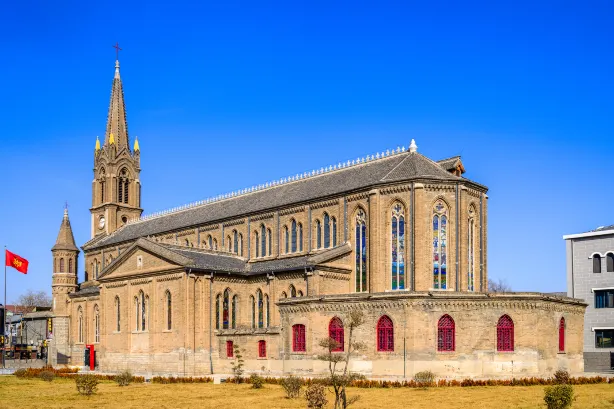
Daming Catholic Church, also known as the "Cathedral of the Mother of Grace", is located on East Street, Daming County, Handan City, Hebei Province. It was built in the seventh year of the Republic of China (1918) and is a typical Gothic building. Daming Catholic Church was built with the "Boxer Indemnity" and supervised by French priest Father Hao. It was "consecrated" and named by French Bishop Liu. The building area is about 1,440 square meters and consists of a bell tower and an auditorium. The church is cross-shaped with the front facing north. The hall is tall and spacious with a dome supported by 14 round stone columns more than 6 meters high. There are more than 100 multi-pane windows of various styles on the surrounding walls, all inlaid with colorful glass, with different flower patterns. There is an extra-large organ at the north end of the church, which is 6 meters high and 5 meters wide. The church bell tower is embedded with four large clocks with a diameter of 1.42 meters. Daming Catholic Church provides an important physical example for the study of cultural exchanges between China and the West.

Mother of Grace Cathedral, Daming

user-avatar
旷野狼9 November 2026
5.0
Of the Five Sacred Mountains, Mount Tai is the most revered. The hike from Hongmen to Yuhuangding is a classic experience, with breathtaking scenery along the way. Stone carvings dot the route, dating back to the Tang Dynasty and more recently to the Republic of China era, creating a historical corridor. Confucius said, "Ascending Mount Tai, one feels the world is small."

Mount Taishan

user-avatar
Anonymous user9 November 2026
4.0
The theme park is a 1:1 replica of Zhang Zeduan's "Along the River During the Qingming Festival" painting, depicting the Bianliang period. Because it is circular, you can walk around from the welcoming gate to the Duanmen gate. There are performances at different times during the day and evening. In the afternoon, there is a fairy scattering flowers on the city wall of the Cold Weapon Museum, followed by a live cannon fire performance of the Battle of Tokyo on the inner lake. In the evening, you can watch the iron flower performance. If you don't queue for the rides, you can easily walk around for half a day and then in the evening to finish the park. It is perfect to come during the Qingming Festival to have a subtle sense of stepping into the "Along the River During the Qingming Festival" painting of the Song Dynasty.

Millennium City Park

user-avatar
火 火28 October 2026
5.0
Guangfu Ancient City is a 5A scenic area in Handan, a rare combination of a water town, an ancient city, and a Tai Chi city in northern China. Entry is free, but separate tickets are required to climb the city walls, visit the government offices, and see the former residences. Key attractions: 1. Ming Dynasty City Wall: Well-preserved, offering panoramic views of the surrounding depressions and waterways, perfect for photos; the South Gate, Yanghe Gate, is a landmark photo spot. 2. Tai Chi Cultural Sites: The former residences of Yang Luchan and Wu Yuxiang, the birthplace of Yang and Wu styles of Tai Chi, where you can see late Qing Dynasty residences and inscriptions on Tai Chi theory. 3. Guangping Government Office: A Ming and Qing Dynasty government office complex, recreating the layout of an ancient government office; often featuring light shows and folk performances at night. 4. Night Cruise on the Moat: Enjoy a boat ride with a strong nighttime atmosphere; iron flower performances are also held on holidays.

Guangfu Ancient City

user-avatar
Anonymous user9 November 2026
5.0
The heavy rain ruined the experience; we traveled a long way to visit, only to be soaked to the bone. If the weather were sunny, it would be perfect for a leisurely stroll with kids, immersing us in this ancient culture.

Jinci Temple Museum

user-avatar
哈哈19825 November 2026
4.0
The price is quite reasonable. The main attractions are the performances and the interactive games with NPCs in the park where you can win silver tickets. I wouldn't recommend it when it's crowded. The "Three Attacks on Zhu Family Village" and "Iron Flower Show" require reservations after entering the park, which are quite difficult to book. Overall, it's okay.

Wansuishan Martial Arts City

Trip Moments in Daming

Popular cities near Daming

Frequently asked questions

What are the recommended tours and excursions in Daming?

When choosing a tour, start with how much time you have and the kind of experience you're looking for. Trending options right now include Anyang: Yin Xu ruins, Yinxu Museum and National Museum of Chinese Writing private hotel transfer 1-day tour, 1-day tour of Handan Museum + Guangfu Ancient Town + Xuebu Bridge + Congtai Park with bilingual service (Chinese-English), and 1-day tour to Youli Ancient City Site + National Museum of Chinese Writing + Yin Xu Palace in Anyang, Henan with Chinese-English service. Check the real-time availability and itinerary before you book.

As of 10 November 2026, the reference price for day tours and activities in Daming is around IDR 17,86,068 – IDR 34,17,211. Rates vary by duration, group size, transport, tickets, meals, and any special admission requirements. Before you book, please confirm the billing currency and whether the price is quoted per person or per group.

Get help anytime, anywhere within 30 secondsContact customer support

Change and cancellation policies vary by attractions and tours. Please check the product details page for more information.

Ticket prices may vary between weekdays and weekends, as well as during peak and off-peak seasons. When booking with Trip.com, you can also use Trip Coins to get extra savings. For more tips on booking discounted tickets, please visit Trip.com for the latest information.