
Things to do in Xi County
Explore top experiences
Top 10 attractions in Xi County


Little Western Paradise
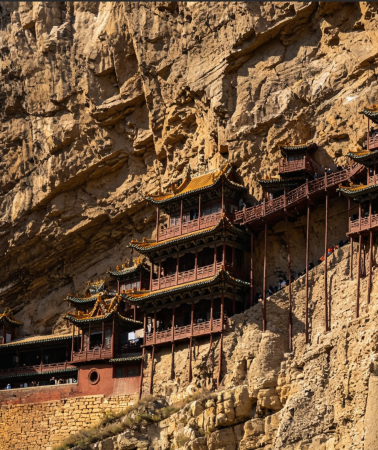
Little Western Paradise is perched atop Phoenix Mountain in Xi County, Linfen, Shanxi Province. This Buddhist temple, originally named the Thousand Buddha Nunnery, was established during the Chongzhen era of the Ming Dynasty. It earned its initial name from the thousand Buddha statues enshrined in its Main Hall of the Great Hero. Later, it was renamed due to the inscription "Entering the Western Paradise" above its gate and to distinguish it from another ancient temple, "Great Western Paradise," located south of the city. Surrounded by mountains on three sides and facing a river in front, the temple is compact yet ingeniously laid out across its upper and lower courtyards. Ascending the stone steps and passing through the secluded "Heavenly Grotto" corridor evokes a sense of gradually entering a Buddhist paradise. The upper courtyard centers around the Main Hall of the Great Hero, flanked by the Manjusri Hall and Samantabhadra Hall. The Main Hall is the temple's crowning jewel: within its modest 100-square-meter space, nearly 2,000 suspended sculptures adorn niches, gables, beams, and rafters, transforming the hall into a museum of suspended sculpture art. Five interconnected niches dominate the rear wall, housing the Medicine Buddha, Amitabha, Sakyamuni, Vairocana, and Maitreya seated on lotus thrones, with ten principal disciples standing beside them. The southern wall depicts Buddhist narratives featuring the Four Sages and Four Heavenly Kings, while the northern wall portrays the 33 celestial palaces of Mount Sumeru. Flying apsaras, divine birds, and musician bodhisattvas dance among clouds on the beams, their gilded polychrome surfaces retaining vibrant hues after centuries. This rare collection of late Ming to early Qing suspended sculptures has gained wider recognition since the temple became a filming location for the popular game Black Myth: Wukong, attracting many travelers for dedicated visits. The lower courtyard also rewards exploration: the Immeasurable Hall faces east, where dozens of bronze Buddha statues interplay with wooden celestial palaces in what was once the monks' meditation hall. Opposite stands the Skanda Hall, housing a single nanmu-carved statue of Skanda. The temple also preserves thousands of volumes from the Yongle Northern Canon, a Ming imperial gift. Visitors are advised to spend extra time in the Main Hall—dim lighting requires slow, upward gazes to appreciate the intricate details of the high-placed sculptures. After exploring both courtyards, one can ascend Solitary Paulownia Peak via the "Seemingly No Path" route behind Skanda Hall, where the Cloud-Touching Pavilion offers panoramic views of the rural landscape below.Xi County · 1.2km from downtown

Xiaoxitian Temple - Mahavira Hall
The Main Hall is a Buddhist structure of significant religious and cultural significance in Linfen City, Shanxi Province. As one of the core buildings of the Xiaoxitian Scenic Area, the Main Hall attracts numerous visitors and believers with its rich history and exquisite architectural art. The Main Hall is the main hall dedicated to Sakyamuni Buddha in a Buddhist temple. It houses a majestic Buddha statue, surrounded by exquisite murals and carvings, showcasing the unique charm of Buddhist art. The hall's elegant architectural style and rigorous structure embody the essence of traditional Chinese architecture. Every year, the Main Hall attracts a large number of believers and tourists for worship and sightseeing. Here, believers can pray and worship, immersing themselves in the profound heritage of Buddhist culture. Visitors can also gain a deeper understanding of Chinese Buddhist culture and history by admiring the artwork and architectural details within the hall. The Main Hall is not only a center of religious belief but also a vital part of cultural heritage. Through its rich history and cultural heritage, the Main Hall of Linfen Xiaoxitian offers a precious opportunity to explore and experience Buddhist culture.Xi County · 1.2km from downtown

Xi County Drum Tower
The Drum Tower in Xi County, Linfen, consists of a pier and a pavilion on the pier. It is about 20 meters high. The beam structure, plaque, etc. are original from the Ming Dynasty.Xi County · 359m from downtown

Emperor Qinshihuang's Mausoleum Site Museum
Emperor Qinshihuang's Mausoleum Site Museum, also known as the Terracotta Army, is located about 1.5 kilometers east of the Mausoleum of the First Qin Emperor and forms part of the extensive necropolis. There were more than a thousand terracotta soldiers unearthed here, each with a different facial expression. Standing before the massive underground army, you will feel the extraordinary might of the Qin Emperor that enabled him to unify six warring states two thousand years ago. The Qin Emperor Ying Zheng began building the mausoleum for himself at the age of 13. Nearly 720000 men and 38 years were required to complete this vast project.China · Xi'an

The Hukou Waterfall Scenic Area
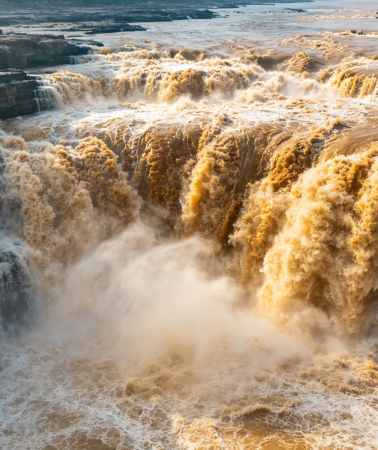
The Hukou Waterfall is a famous waterfall on the Yellow River. The roiling water of the Yellow River roars downward here with great power. The Hukou Waterfall area is divided by the Yellow River. On the west side is Yichuan County, Shaanxi, and on the east side is Ji County, Shanxi. The waterfall is also divided into the Hukou Waterfall (the part of the falls in Shaanxi) and the Shanxi Hukou Waterfall (the part of the falls in Shanxi). Separate tickets are sold for each area. The Shanxi section of the Hukou Waterfall is located 45 kilometers west of the seat of Ji County in Linfen City, Shanxi.Ji County · 75.9km from Xi County

Longmen Grottoes
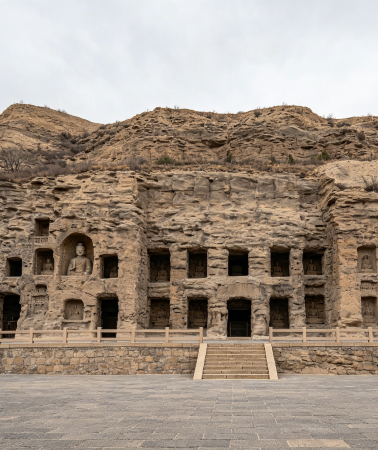
One of the four major grottoes of China and a UNESCO World Heritage Site, the Longmen Grottoes are a trove of 1000 years of Buddhist art treasures. Bounded by the Yi River, the caverns are divided into two sections at East Hill and West Hill. The caverns at East Hill contain mostly Tang dynasty (618-907) works, while the caverns at West Hill were cut out during the Northern, Sui, and Tang dynasties and contain the carvings that are most representative of the site. The Buddha and bodhisattva sculptures that inhabit the caverns are carved into an endless variety of poses and expressions of mercy and kindness, while the caves themselves lend a stately and dignified atmosphere. The artistry of these sculptures is truly a priceless inheritance of Buddhist art.China · Luoyang

Thousand-Buddha Cave (Niujiagou)
Xi County · 7.7km from downtown

Jinci Temple Museum
Jinci Temple is located on the banks of the Jin River at the foot of Xuanweng Mountain, 25 km southwest of Taiyuan. It was built by later generations to commemorate Tang Shuyu, the founding feudal lord of the Jin State, and served as the ancestral temple of the Jin State. It is often said that "a visit to Taiyuan is incomplete without seeingJinci Templethe saying "a wasted trip to Taiyuan". After getting off at Jinci Temple, the first place you'll reach isJinci MuseumThis is a free park with a pleasant environment, perfect for casual strolling. After about a 10-minute walk through the park, you'll reach the main area of Jinci. Inside Jinci Museum,Jinci TempleThe "Three Treasures" (Xian Hall, Flying Bridge Across Fish Pond, and Shengmu Hall) and "Three Wonders" (Zhou-bai, Nanlao Spring Pavilion, and painted clay sculptures) are must-sees for every visitor toJinci Templeview that everyone must see. Jinci TempleThe "Three Treasures" are connected and located atJinci Templeon the central axis, allowing for a combined visit. Xian Hall is a place for offering sacrifices, with fence-like walls on all four sides, providing good ventilation and coolness. Notably, not a single iron nail was used in the beams and pillars throughout the hall. The Flying Bridge Across Fish Pond is located in front of Xian Hall and was built during the Song Dynasty. The entire view resembles a modern overpass, making it the only existing example among ancient bridges in China. One end of the "Flying Bridge" connects to Shengmu Hall, which is the earliest existing main building in Jinci Museum. The main hall is spacious, and a major highlight is its beam-and-pillar structure without internal columns. Eight wooden carved coiled dragons, appearing ready to fly, are carved on the eight corridor pillars in front of the hall, which, together with the "Flying Bridge Across Fish Pond," present a magnificent sight. Centered around the Hall of the Holy Mother, it's easy to find the "Three Wonders." The painted clay figurines are located inside the Hall of the Holy Mother, with the main statue of the Holy Mother seated majestically in a wooden shrine, dignified and resplendent, while the other 42 attendant statues stand on either side. These figurines are dressed in vibrant colors with varied expressions, including one maidservant dressed as a flower-dan (young female role in Chinese opera), her face half joyful and half sorrowful, evoking complex emotions in viewers. Master Mei Lanfang once stood before this maidservant statue for a long time, carefully studying her posture and inner emotions, and praised it highly. The Zhou Cypress, located north of the Hall of the Holy Mother, was planted during the Western Zhou Dynasty and is over 3,000 years old. The Pavilion of the Never-Aging Spring stands south of the Hall of the Holy Mother, where the source of the Jin River flows continuously year-round. In addition,Jinci TempleInside, there is also the extremely precious "Jinci Inscription" stele, personally composed and handwritten by Emperor Taizong of Tang, Li Shimin. At the southernmost part, you can find the Shifang Fengsheng Zen Temple, which is said to have originally been the villa of Yuchi Gong, a founding general of the Tang Dynasty. In the northern part of the temple complex, the Futu Courtyard houses the Sheli Shengsheng Pagoda. Climbing the pagoda offers a panoramic view.Jinci TempleThe panoramic view is clearly visible.China · Taiyuan

Hukou Waterfall tourist area of the Yellow River
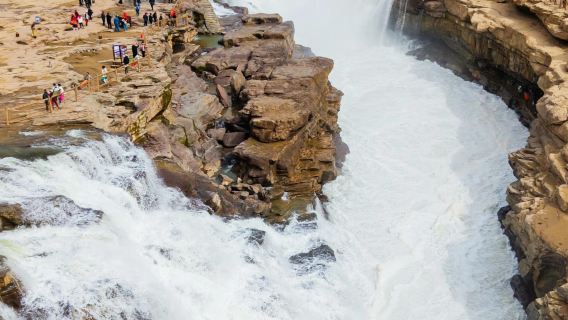
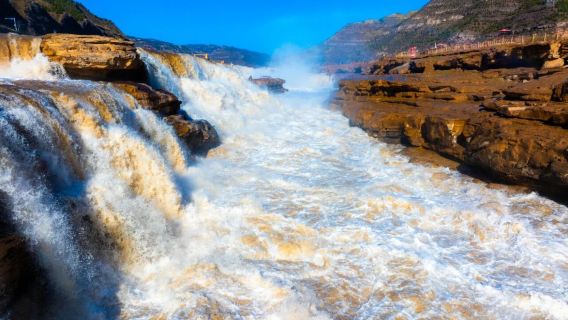
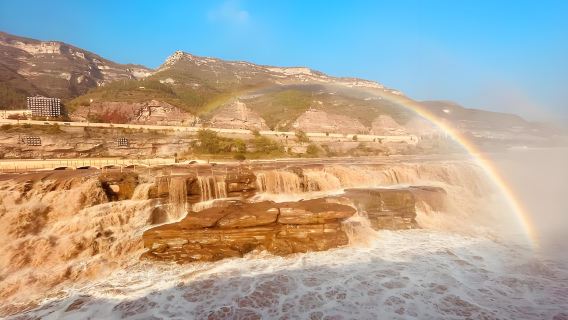
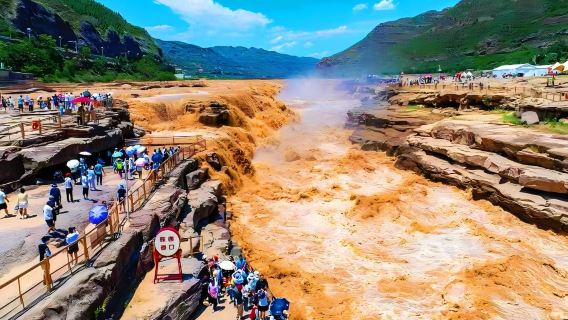
The Hukou Waterfall tourist area of the Yellow River is located on the riverbed of the Yellow River in the Qin-Jin Grand Canyon, where the provinces of Shanxi and Shaanxi face each other across the river. The main stream of the Yellow River, originally hundreds of m wide, suddenly narrows to dozens of m and plunges into a deep trough with a drop of 20–30 m, resembling water being poured from a giant pot—hence the name "Hukou" (Pot Mouth). Due to the large amount of sediment carried by the river, the waterfall presents a rare golden-yellow view: the turbid waves roar down with a sound like distant thunder rolling through the valley, while the rising mist lingers before the cliff, earning the nickname "smoke rising from the water." On sunny days, sunlight casts a rainbow over the waterfall, known as "a rainbow playing in the water." The mist may drench visitors even without wind or rain, creating the wonder called "rainfall under a clear sky." Hukou waterfall is regarded as the symbol of the "soul of the Yellow River" and the spirit of the Chinese nation. In 1938, when poet Guang Weiran crossed the Yellow River, he witnessed the roaring waves of Hukou and the boatmen's chants, which inspired him to create the now-legendary Yellow River Cantata. Liang Heng's essay of the same name was selected for middle school Chinese textbooks, and the back of the fourth series CNY 50 banknote also features this scene. Many first learned about it through textbooks and currency before visiting in person. In the past, cargo ships had to leave the water and bypass the waterfall here, leaving behind the maritime memory of "sailing on dry land." The scenery here varies with the seasons: In early spring, the upstream ice melts and the water level rises sharply, coinciding with the blooming of mountain peach blossoms on both banks, known as the "March peach blossom flood." In midsummer, the rainy season brings abundant water, with muddy waves towering into the sky. After fall begins, the rainy season subsides, and the water becomes high and steady. As the fall breeze sweeps by, rainbows often appear, earning the name "Hukou autumn breeze." In deep winter, layers of ice form along the banks, and overflow freezes into inverted ice peaks, glistening under the sunlight, creating the spectacular "upside-down ice peaks." The viewing platform on the Shaanxi side stretches along the cliff top on the western bank, offering a commanding view of the "thousand-mile Yellow River funneled into one pot" and the ten-mile-long Dragon Trough below the waterfall. During high-water seasons, the mist is heavy, and clothes get soaked quickly, so remember to protect your camera and phone; the boardwalk is slippery, so watch your step while walking and taking photos.Yichuan · 77.4km from Xi County

Mount Hua
Mount Hua, formerly known as "Xiyue", is one of the five famous mountains in China. It is located in Huayin City, Shaanxi Province. Huashan is also known as "Taihuashan". It is the birthplace of Chinese civilization. The "Hua" in "Zhonghua" and "Huaxia" comes from Huashan. The words "strange and dangerous" are the essence of Huashan's scenery. "Since ancient times, there has been only one road to Huashan" describes the steepness of Huashan. The Attraction has many thrilling attractions such as Changkong Plank Road, Kitesurfing, Qianchi Chuang, Baichi Gorge, Laojun Ligou, etc., which are carved out on the steep cliffs. Those who visit them in person will be amazed. Huashan Attraction covers a vast area, including the Main Peak Attraction, Xiyue Temple Attraction, Xianyu Attraction, etc. The Main Peak Attraction is the core Attraction of Huashan, including "Huashan One Road" and the five main peaks in the southeast, northwest, and center. Huashan in most people's minds refers to the Main Peak Attraction. Five main peaks The East Peak is about 2,100 meters above sea level and is named for its location in the east. There is a platform on the top of the peak, which is high and dangerous with a wide view. It is a good place to watch the sunrise. It is called Chaoyang Terrace, and the East Peak is also called Chaoyang Peak. The East Peak consists of four peaks, one main peak and three s-ervant peaks. The peak where Chaoyang Terrace is located is higher, the Yunv Peak is in the west, the Shilou Peak is in the east, and the Botai is in the south. There are more than dozens of landscapes on the East Peak. There is a natural stone pattern on the cliff on the side of the East Shilou Peak, which looks like a giant palm print. This is the Huayue Immortal Palm, which is listed as the first of the eight scenic spots in Guanzhong. The story of the giant spirit opening the mountain and guiding the river originated from this. The West Peak is about 2,000 meters above sea level. Because there is a huge rock on the top of the peak that looks like a lotus petal, ancient literati often called it Lotus Peak or Hibiscus Peak. Xu Xiake wrote in his "Diary of Traveling to Mount Taihua": "There is a rock rising on the peak, and there are stone pieces covering it, like a lotus flower." This stone must be referring to it. There are many landscapes on the West Peak, including Cuiyun Palace, Lotus Cave, Giant Spirit Foot, Axe-Split Stone, Sheshen Cliff, etc., and there are many beautiful myths and legends. Among them, the well-known story of Chenxiang splitting the mountain to save his mother is circulated here. The South Peak is over 2,100 meters above sea level and is the highest peak of Huashan. The ancients called it the "Head of Huashan". On one side of the South Peak is a thousand-foot cliff, standing straight like a knife, and below is a deep ravine, which is separated from Sangong Mountain and Sanfeng Mountain. The South Peak consists of one peak and two peaks. The east side is called Songhui Peak, and the west side is Luoyan Peak. The origin of the name of Luoyan Peak is said to be because the migrating wild geese often land here to rest. The North Peak is about 1,600 meters above sea level, with cliffs on all sides, covered with clouds above and connected to the earth veins below. It stands tall and unique, and is also called Yuntai Peak because it looks like a cloud platform. Li Bai of the Tang Dynasty wrote in his poem "A Song of the Cloud Platform of Mount Xiyue to Complimentary Danqiuzi": "Three peaks stand as if about to collapse, and the green cliffs and red valleys are high. The golden essence of the White Emperor mobilizes his vitality, and the stones become lotus flowers and the clouds become platforms." The famous story of "Taking Huashan by Strategy" took place here. There are many landscapes on the mountain, including the Zhenwu Hall, Jiaogong Stone Chamber, Changchun Stone Chamber, and the place where Laojun hung the plow. The Middle Peak is the only way to the other four peaks. It is located in the middle of the East, West and South Peaks. The forests on the peak are lush and green, and the environment is quiet. There is a Taoist temple named Yunu Temple on the top of the peak. It is said that it was the place where Qin Mu Gong's daughter Nong Yu cultivated herself in the Spring and Autumn Period, so it is also called Yunu Peak. Main landscape: There are more than 210 famous Attraction in Huashan. From ancient times to the present, countless literati and poets have left various classic poems here. Skywalk The Changkong Plank Road is located on the east side of the Huashan South Peak. It was built by the master of the Huashan School, Taoist He Zhizhen of the Yuan Dynasty, who wanted to get away from the world and practice Taoism. He built it by inlaying stone piles on the cliffs and paving wooden boards. At the end of the plank road, you can see the "Hezu Cave" where Master He practiced self-cultivation. The road builders chiseled stone holes on the cliffs, wedged stone piles into the holes, and laid wooden boards about 40 cm wide between the stone piles. Visitors must stick to the cliff wall, pull the iron chain with their hands, step on the wooden boards, and move forward slowly sideways. Xiyue Temple Xiyue Temple, also known as Huayue Temple, is a temple where emperors of all dynasties worshipped and offered sacrifices to Shaohao, the Great Emperor of Xiyue. It was first built during the Yuanguang period of Emperor Wu of the Han Dynasty (134-129 BC) at the entrance of Huangshengu (now Huangfuyu) at the foot of Huashan Mountain. It was moved to its current location during the reign of Emperor Huan of the Eastern Han Dynasty (147-167 AD) and renamed today. It was rebuilt many times during the Tang, Song, Ming and Qing dynasties. Canglong Ridge The steps on Canglong Ridge are only 2 feet wide, with deep ravines on both sides, as steep as a knife. The height difference between the ridge and the top is about 500 meters, and the slope is more than 45 degrees. Looking at the green pines and white clouds in the distance and hearing the sound of the wind is dizzying. Jinsuoguan Jinsuoguan is one of the five passes of Huashan Mountain. It is built on a stone archway at the entrance of the three peaks. It is the throat of the Wuyun Peak to the four peaks of East, West, South and Center. There is no way to pass after the pass, so it is also called Tongtianmen. Taoists believe that Huashan is the fairyland of gods. Only after passing Tongtianmen can you enter the fairyland. Therefore, there is a folk song that "after passing Jinsuoguan, there is another world". There has been only one road to Mount Huashan since ancient times "There has been only one road to Mount Hua since ancient times" refers to the "Huashan Valley" hiking trail, which includes various scenic spots along the Huashan hiking trail since ancient times. When connected together, it is what is commonly referred to as "There has been only one road to Mount Hua since ancient times." How to visit Huashan has two mountain gates (entrances): East Gate and West Gate (also known as Huashan Gate). Take the cable car up the mountain and go to the East Gate; if you climb the mountain on foot, enter from the West Gate. Huashan currently has two cable cars, the East and West Lines, which reach the North Peak and the West Peak respectively (please plan the climbing route in advance before purchasing the ticket and purchase the corresponding ticket type, and you cannot change it midway.). Route 1: Hiking route There has been only one road on Mount Huashan since ancient times. It is an ancient mountaineering road with a total length of 12.5 kilometers and 9,567 steps. It takes about 4 hours to hike from Yuquanyuan, through Wuli Pass, Shaluoping (night climbing), Qianchi Chuang, Baichi Gorge, etc. to the North Peak, and then start the tour from the North Peak. Route 2: "Up West and Down West", a mountaineering route suitable for the Seniors and tourists with children This route goes up the West Peak Cableway of Mount Huashan and down the West Peak Cableway, that is, going up from the west and down from the west. The whole route takes a relatively short time, about 4 hours, and is also more energy-saving, making it more friendly to the Seniors and tourists with children. Route 3: "Up West and Down North", a one-day mountaineering route chosen by 80% of tourists This route goes up by cable car from the West Peak of Mount Huashan and down by cable car from the North Peak, that is, going up from the west and down from the north. The entire route is a classic one-day tour route, which takes about 6 hours. You can visit all the attractions without backtracking. Most tourists choose this route because this road almost goes straight down, which is easier and faster than the uphill road. Route 4: "North up and north down", a time-saving, economical and panoramic mountaineering route This route goes up by cable car at the North Peak of Huashan and down by cable car at the North Peak, that is, going up from the north and down from the north. The whole route is a relatively low-cost cable car mountaineering route. If your sightseeing time is limited, you can choose this route and visit the North Peak, which has the Memorial Pavilion, Ear-Crushing Cliff, Canglong Ridge, Huashan Sword Contest Monument, panoramic Huashan and other attractions.China · Huayin
Experiences you can't miss in Xi County
Featured Day tours in Xi County
View all Day tours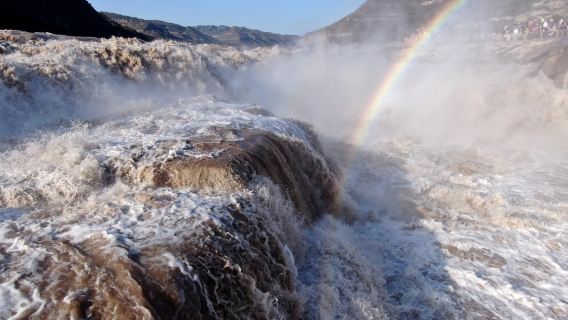
5.0/5
· 2 reviewsFree cancellation
Instant confirmation
From€109.15
Free cancellation
Instant confirmation
From€128.86
5% off
Limited-time sale
From€201.61€212.23
![Hukou Waterfall tourist area of the Yellow River 1-day tour [door-to-door pickup│optional skip-the-line]](https://ak-d.tripcdn.com/images/0350412000q8nl0kh22AB_C_568_320.jpg?_fr=wc)
5.0/5
· 2 reviews· 73 bookedFree cancellation
Instant confirmation
Book now for tomorrow
From€38.42
5.0/5
· 4 reviews· 23 bookedFree cancellation
Instant confirmation
Book now for tomorrow
From€42.43
From€55.94
5.0/5
· 1 reviewFree cancellation
Book now for tomorrow
From€284.99
4.0/5
· 1 reviewFree cancellation
Instant confirmation
Book now for tomorrow
From€39.76
Free things to do in Xi County
Little Western Paradise
Xi County · 1.2km from downtownBook now for tomorrow, Cancel anytimeXiaoxitian Temple - Mahavira Hall
Xi County · 1.2km from downtownXi County Drum Tower
Xi County · 359m from downtownEmperor Qinshihuang's Mausoleum Site Museum
China · Xi'anBook now for tomorrow, Cancel anytimeThe Hukou Waterfall Scenic Area
Ji County · 75.9km from Xi CountyBook now for tomorrow, Cancel anytimeLongmen Grottoes
China · LuoyangImmediate access, Book now for today, Cancel anytimeThousand-Buddha Cave (Niujiagou)
Xi County · 7.7km from downtownJinci Temple Museum
China · TaiyuanBook now for tomorrow, Cancel anytimeHukou Waterfall tourist area of the Yellow River
Yichuan · 77.4km from Xi CountyBook now for tomorrow, Cancel anytimeMount Hua
China · HuayinImmediate access, Book now for today, Cancel anytime
More ways to travel from Xi County
Private Tours in Xi County
View More Private Tours in Xi County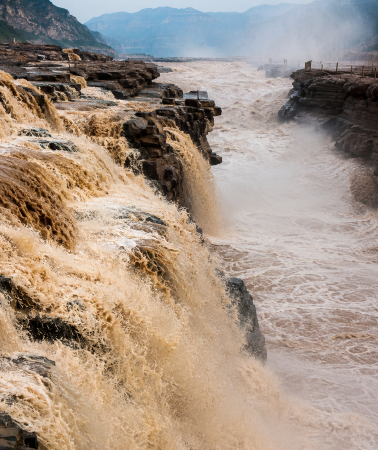


What travellers say about Xi County

Anonymous user10 October 2026
5.0
The main hall, spanning only 170 square meters, is densely packed with nearly 200 suspended sculptures, works from the late Ming Dynasty 400 years ago. These sculptures are crafted from wood and clay, with gold leaf applied to the walls. From the walls and beams to the roof, they depict celestial palaces, flying apsaras, musicians, and mythical birds, intricate yet orderly, with lifelike expressions, earning it the title of the pinnacle of Chinese suspended sculpture.
Little Western Paradise

常霞客20 August 2026
5.0
This place truly deserves its reputation as the pinnacle of suspended sculpture art—firstly, its grand scale and exquisite craftsmanship: the hall is filled with large-scale painted suspended sculptures, totaling nearly 2,000 Buddha statues. These statues vary greatly in size, ranging from 3.2 meters tall to the size of a thumb, with full and vivid shapes, serene expressions, and lifelike features. Secondly, its vibrant colors and resplendent gold: the sculptures are made with natural mineral pigments and covered with a large amount of gold leaf, and even after nearly four hundred years, their colors remain vibrant and their golden brilliance is extremely striking.
Xiaoxitian Temple - Mahavira Hall

山在穷游1 October 2026
4.0
Many people believe that a trip to Xixian County must include a visit to Xiaoxitian, but the county also boasts its own national treasure: the Drum Tower, a vital transportation hub. This tower has stood for centuries, witnessing the development of Xixian County, and remains a major transportation center.
Xi County Drum Tower

Noam Galpaz Angel16 October 2026
5.0
The terracotta warriors museum is located and hour away from x'ian city center. We got there at the last entrance slot, which we highly recommend, by the time we got there most people were leaving. Once inside we recommend you start at pit 3 and work your way to pit 1 at the end. It was almost empty by the time we got there! The entrance using trip tickets was convenient and easy. We also got an audio guide on site.
Emperor Qinshihuang's Mausoleum Site Museum

yangliaopan15 October 2026
5.0
We got a combined ticket for Shanxi and Shaanxi, and we went to the Shanxi section first.
We experienced the majesty of the Mother River, there were stage performances,
we had photo opportunities with little donkeys (suitable for children), and
we could drive to the other side of the Shanxi section.
The Hukou Waterfall Scenic Area

Hazel_Zayne14 October 2026
5.0
The Vairocana Buddha is truly breathtaking. History buffs can hire a guide, but regular tourists can explore on their own (I listened to a 2-hour guided tour but didn't remember much...). In short, seeing the Buddha is worth it. The night view is beautiful, the scenic area isn't large, and the layout is simple and logical—perfect for lazy people! ✌️
Longmen Grottoes

M46***7615 October 2026
5.0
Taiyuan, the birthplace of the Tang Dynasty, boasts attractions such as Nanlao Spring, Tang Shuyu Temple, Shengmu Hall, Fish Pond Flying Bridge, and Tang Stele. The area is blessed with natural beauty and cultural richness, and visitors can even enjoy free admission to concert venues.
Jinci Temple Museum

IVERSON352013 October 2026
5.0
Great! The Shanxi and Shaanxi combined ticket is fantastic. Two days valid, excellent value for money. Both places are quite fun. In Shaanxi, you can book a free show of the "Yellow River Cantata," which is very good and worth the ticket price. The shuttle bus is very convenient, with frequent departures and short waiting times. A great travel experience, highly recommended.
Hukou Waterfall tourist area of the Yellow River

MLIF.15 October 2026
5.0
Mount Hua, as a natural scenic area, combines ruggedness and grandeur. Climbing to the summit is extremely challenging; treacherous paths like the Plank Road in the Sky require careful ascent, but the breathtaking peaks and seas of clouds along the way are truly awe-inspiring. The scenic area boasts well-developed facilities and robust safety measures. Overall, Mount Hua is a highly recommended destination for outdoor adventure and nature appreciation, suitable for physically fit travelers who enjoy a challenge. It is advisable to plan your route in advance and prepare your equipment accordingly.
Mount Hua


