





 4.8/5
4.8/5 M2f***ro
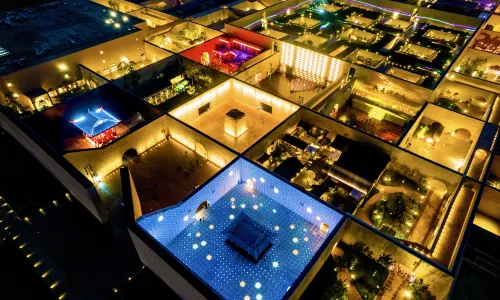
Today's visit to "Only Henan: A City of Theatrical Fantasy" deeply moved me. In the grand narrative of *The Railway Station Theater*, I witnessed a poignant and intense brotherly bond—Li Shiyi, the elder brother of Li Shiba, harboring an almost tragic tolerance and boundless love for his brother. The horrors of the 1942 Henan famine were reenacted on stage, the desperate scene of starving people scrambling for food was suffocating. When Li Shiyi, desperately seeking some life-saving seeds from his brother, the stationmaster, learned that the price would be his brother's life, his world crumbled instantly. Ultimately, Li Shiba opened the granary to distribute the grain, sacrificing himself in the process. Li Shiyi's madness and breakdown upon learning all this vividly portrayed the struggle of humanity under extreme circumstances. The smaller theater production *Wheat, Oh Wheat* depicts the resilient landscape of the people of Henan, who have depended on the land for thousands of years. Those simple and hardworking farmers, dedicating their lives to the wheat fields, saw wheat not only as food but also as their roots and soul. With the southward advance of the Jin army at the end of the Northern Song Dynasty, Henan was forever cut off from the dynastic capital, a historical turning point tinged with desolation and regret. Another short play, "Su Shi's Henan," succinctly portrays the tumultuous life of the literary giant Su Shi in just thirty minutes. From his initial fame through the imperial examinations, to his repeated demotions and fluctuating fortunes, until his eventual pardon but failure to return to the capital Bianjing, where he died and was buried in Henan, his poetry is filled with a magnanimous outlook on life and an optimistic view of hardship. Yet, isn't this also a kind of spiritual transcendence under the pressure of reality? Behind that "forced magnanimity" lies a profound undercurrent of unfulfilled ambition throughout his life. This trip was not merely a theatrical experience, but a profound dialogue with the land, history, and the depths of human nature.
 4.4/5
4.4/5 彤彤公主的大保镖
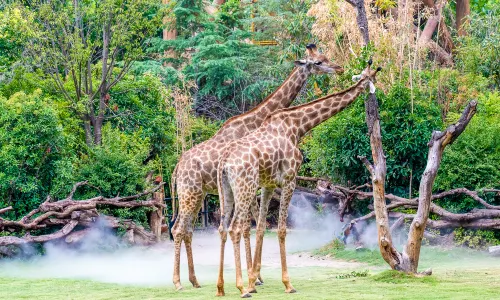
It's really good, one of the better ones in the province. It's like a zoo and amusement park complex. There weren't many people on the weekdays, so there was no need to queue. However, there aren't many animals at the moment, and the rides seem a bit noisy. I wonder if they'll disturb the animals?
 4.8/5
4.8/5 M52***87
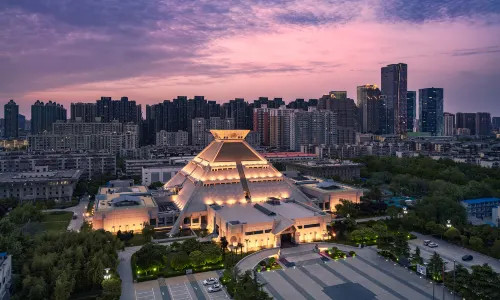
The Henan Museum's exhibition on Confucius's travels around the states: This classic portrait is probably in every school...we've seen it since we were little. Although we don't know what Confucius actually looked like, the Sage Master was indeed a strong man over nine feet tall... Confucius looked like Yang Hu, and one of his disciples looked very much like him. It seems many portraits of ancient figures depict two large front teeth...like Confucius, the Yellow Emperor, Shennong...perhaps this was an auspicious omen for sages (or immortals) in the eyes of the ancients. The earliest known portrait of Confucius was unearthed from the Haihunhou Tomb (along with the Qi Analects, the Book of Songs, 125 kilograms of gold, and a mountain of copper coins...). The Confucius Family Mansion's collection, "Illustrations of Sacred Sites," depicts the main events in Confucius's life from childhood. In the childhood portrait, who is wearing a hat? A headscarf? Is that child Confucius...? There's also a rubbing of a brick depicting Confucius asking Laozi about rites, and a short animation of it, which is quite interesting. (I wonder if the Confucius Mansion will publish a comic book version of "Illustrations of Sacred Sites"?) The "Illustrations of the Book of Songs" is very interesting, but unfortunately, only a small section can be seen. Confucius's hometown was in the State of Song. Confucius traveled to many countries. He visited the State of Qi. "In Qi, upon hearing the Shao music, I forgot the taste of meat for three months." Qi was known for its beautiful women, the most famous probably being the one in the poem "Shuoren" (The Great Woman). "The Great Woman of Wei" "The Great Woman is tall and slender, dressed in brocade and a simple robe. She is the daughter of the Marquis of Qi, the wife of the Marquis of Wei, the younger sister of the Crown Prince, the aunt of the Marquis of Xing, and the concubine of the Duke of Tan. Her hands are like tender shoots, her skin like congealed fat, her neck like a cicada's, her teeth like melon seeds, her forehead broad and her eyebrows arched, her smile enchanting, her eyes bright and beautiful." Xuan Jiang, from the poem "Two Sons in a Boat," was also a beauty from Qi (and married into Wei...it seems the rulers of Wei were either licentious and tyrannical, or utterly foolish...how could such a small state survive until the end of the Warring States period...) *The Book of Songs: Two Sons in a Boat* Two sons in a boat, drifting aimlessly. I long for my sons, my heart aches with longing! Two sons in a boat, drifting aimlessly away. I long for my sons, without fear of harm! The brotherly love between Ji Zi and Gongzi Shou is truly touching! Especially considering the many fratricide during the Spring and Autumn and Warring States periods... I once visited Wei. Confucius said, "I have never seen anyone who loves virtue as much as he loves beauty." Confucius met Nanzi. "Heaven despises him! Heaven despises him!" There was a movie called *Confucius* starring Chow Yun-fat and Zhou Xun, with Faye Wong singing the theme song. Although Nanzi's headdress was a bit bizarre, the movie was alright... I once got lost at the east gate of Zheng... "Confucius went to Zheng, and lost his disciples. Confucius alone..." A man from Zheng said to Zigong, “There is a man at the east gate of Zheng. His face resembles Yao, his neck resembles Gao Yao, and his shoulders resemble Zichan. However, from the waist down, he is three inches shorter than Yu, and he looks like a homeless dog.” Zigong told Confucius the truth. Confucius laughed and said, “Appearance is secondary. But to say he looks like a homeless dog, is that true? Is that true?” This east gate of Zheng should be the same east gate from the poem “Going out of the east gate, there are women like clouds.” (From the *Zheng Feng* section of the *Book of Songs*, "Going out of the East Gate") Going out of the east gate, there are women like clouds. Though they are like clouds, they are not what I desire. In white robes and black kerchiefs, they bring me joy. Going out of the gate, there are women like withered leaves. Though they are like withered leaves, they are not what I desire. In white robes and withered leaves, they bring me some amusement. It is hard to imagine that, surrounded by joyful young men and women, Confucius wandered aimlessly, looking like a homeless dog. The city gate currently under construction in Zhenwei River City is probably the East Gate. Perhaps NPCs could play the role of disciples, searching for Confucius amidst a sea of beautiful women... (But this would require a tall, refined, and robust man...) The *Records of the Grand Historian* states, "In the past, King Wen of Zhou was imprisoned in Youli, where he developed the *Book of Changes*; Confucius was trapped in Chen and Cai, where he wrote the *Spring and Autumn Annals*; Qu Yuan was exiled, where he composed the *Li Sao*." He was once trapped between Chen and Cai. He did not eat for seven days, yet his music and singing never ceased. Today, there is still a "Musical Stage" in Huaiyang, Zhoukou, to commemorate him. The State of Chen also had many beautiful women. Lady Xi, also known as Lady Peach Blossom, was the daughter of the ruler of Chen. She married the Marquis of Xi, but was later forcibly taken by the King of Chu. There was a short animation about Lady Xi in *Six Hundred Years of Cai* (the Xinyang Museum also has a statue of Lady Xi, as well as Lord Chunshen). Wang Wei wrote a poem: Lady Xi Do not let present favor make you forget past kindness. Tears well up at the sight of flowers, I cannot speak with the King of Chu. There is a beautiful poem in the *Chen Feng* section of the *Book of Songs*, which is the very same poem from Su Shi's *Ode to the Red Cliff*: "Reciting the poem of the bright moon, singing the graceful verses." *Chen Feng* - The Moon Rises The moon rises bright. Beautiful is the fair maiden. Graceful and charming. My heart is troubled. The moon rises white. Beautiful is the radiant maiden. Sorrowful and nurtured. My heart is troubled. The moon rises shining. Beautiful is the dazzling maiden. Graceful and charming. My heart is filled with sorrow. Combining this with other poems from the *Book of Songs* evokes a unique feeling.
 44.8/5
 Anonymous user
I had a great experience at Zhengzhou Fantawild Adventure. The park was at a low peak period, so there were very few people — which made the visit even more enjoyable with almost no queues. The weather was perfect, and all the rides were fun and worth trying. It was also very easy to get to the park. We bought our tickets from Trip.com, which was easy, breezy, and cheaper than purchasing on-site. Overall, it was a smooth, enjoyable, and hassle-free visit!
 54.7/5
 河洛一粟
河洛一粟It's a lot of fun, great value for money, and there are shows. It gets quite crowded on weekends. The security check at the entrance isn't like what you see online, where you can't bring this or that. It's just a normal security check, very simple.
 64.4/5
 M52***13
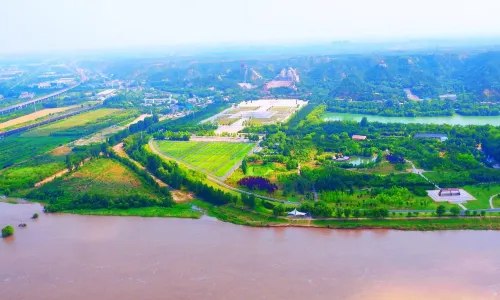
Zhengzhou's cultural park is well worth a visit, fully showcasing Henan's long history. The statues of the Yellow Emperor and the Yan Emperor are truly awe-inspiring, and the geological museum inside is incredibly educational.
 74.5/5M75***22
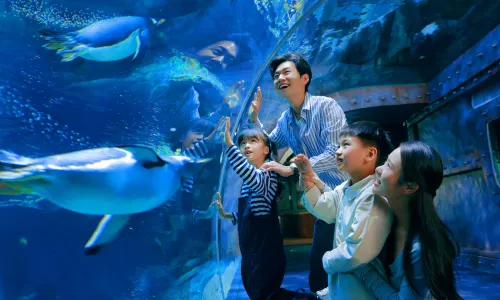
I just don't understand why the music is so loud that it almost breaks my eardrums. As soon as the child goes in, he starts clamoring to get out. I coaxed him to watch a few shows, but he covered his ears the whole time.
 84.6/5Anonymous user
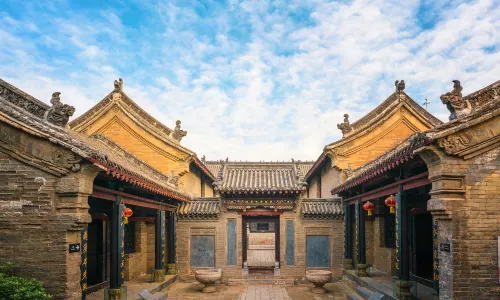
The name "Kang Baiwan" (meaning "Kang the Millionaire") originated from a jest by Empress Dowager Cixi about the Kang family, who were known as the "Living Gods of Wealth in Central China," but the name spread far and wide. The Kang Baiwan Manor, a nationally renowned manor of the wealthy, is now open to the public as a tourist attraction, showcasing a Ming and Qing dynasty manor complex. Facing the Luo River and backed by Mount Mang, the manor's feng shui is undoubtedly auspicious, and the decades-long inheritance of wealth is truly a remarkable story. The manor is not only vast but also incredibly complex. Courtyards connect to courtyards, main roads to side paths, winding and twisting, even revealing secret passages leading up the mountain and hidden treasure vaults—a truly eye-opening experience. There are also performances every day at 11 am, offering a deeper understanding of the history of the Republic of China era, which is quite moving.
 94.6/5
 hucuifang
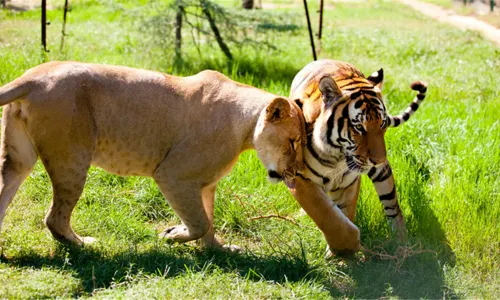
Construction was underway everywhere, with green corrugated iron sheets surrounding the area, making the experience less pleasant than usual. However, it was still worthwhile as a place to take a walk and see the animals along the way. I strongly recommend going after 2 PM; I went around 12 PM, and the animals were all taking their afternoon nap.
 Featured in 2026 China 100 - Night Attractions
