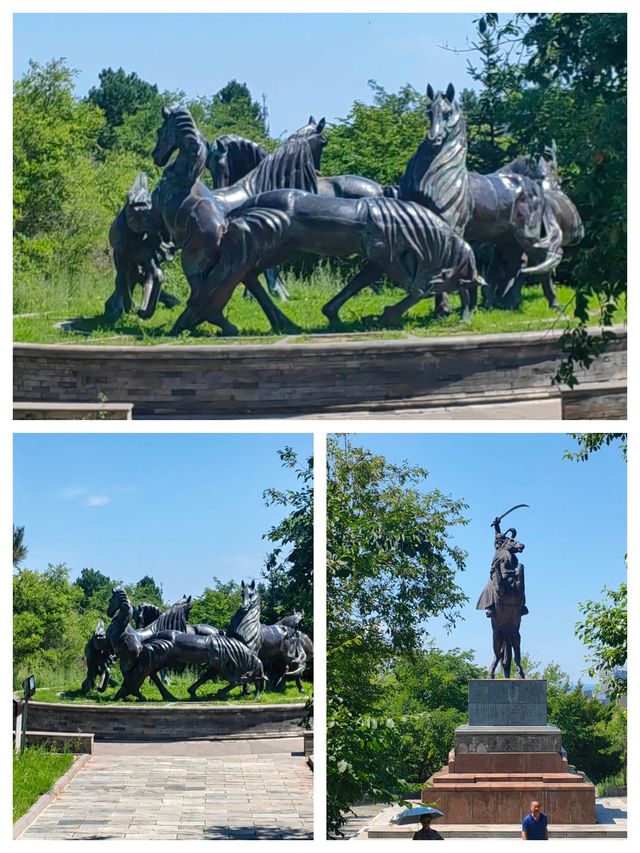
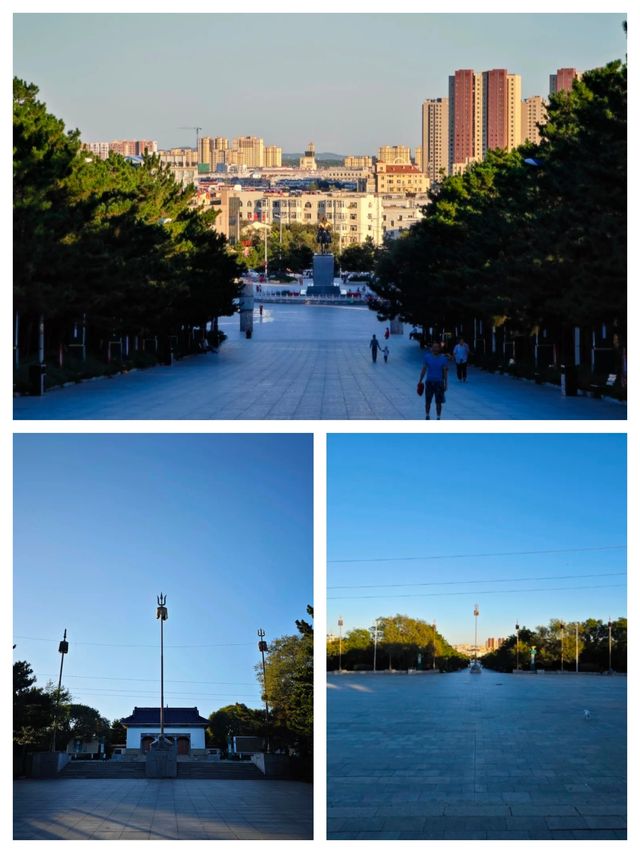
Do you think the legend of Genghis Khan only exists in grassland epics? Wrong! At the peak of Hanshan Mountain in Ulanhot City, Inner Mongolia, there is a "time capsule" that history enthusiasts go crazy for—the only Genghis Khan Temple in the country! While other tourists crowd in front of the mausoleum to take photos, you can stand before this green-roofed, white-walled sacred hall, touch the Mongolian patterns carved by craftsmen in 1940, and feel the imperial aura of "nine times nine equals one" on the 81 steps! Even more amazing, when I visited in October, I encountered the first snow, and the entire temple was covered in white snow, with the golden roof shining under the sun, as if traveling back 800 years to the Mongol Empire! But did you know? This temple hides three "secret identities" that 90% of visitors don’t know about!
1. The Genghis Khan Temple’s “Unbelievable Identity”: It’s not just a temple, but a “hybrid” of three ethnic civilizations
🏯 Architectural Code: A Millennium Dialogue of Mongolian, Han, and Tibetan Cultures
• Exterior Mystery: The green roof and white walls carry deep meaning—green is the color of “Eternal Heaven” worshipped by Mongolians, white symbolizes purity, and the Han-style flying eaves and dougong brackets collide intriguingly with Tibetan prayer flags
• Numerical Metaphor: The 81 steps (9×9) in front of the temple represent “nine times nine equals one,” echoing Genghis Khan’s great achievement of unifying Mongolia; the 36 pillars in the main hall symbolize the 36 tribes of the Mongol Empire
• Temple Treasure: Inside the hall stands a 2.8-meter-tall, 1.5-ton bronze statue of Genghis Khan, cast according to the “nine chi” height recorded in the Yuan History; the base is engraved with excerpts from the “Yassa” (the Mongol Empire’s first legal code)
🌍 Global Uniqueness: The Empire’s Map from East Temple to West Mausoleum
• Together with the Genghis Khan Mausoleum in Ordos, Inner Mongolia, it forms the “East Temple West Mausoleum,” creating an imperial layout “head resting on the Yellow River, feet stepping on the vast sea”
• The only Genghis Khan memorial building in the world jointly built by Mongolian, Han, and Tibetan craftsmen, a fusion of three styles known as the “United Nations of architecture”
• When built in 1940, the Japanese army tried to interfere with the design, but Mongolian craftsmen insisted on adding the yurt element to the roof, resulting in today’s unique “dome + flying eaves” structure
2. Deep Experience: The “Five-Sense Pilgrimage” from the Steps to the Golden Roof
👣 Step Ritual: The “Imperial Walk” on 81 Steps
• Correct Posture: Walk on the Mongolian patterns in the center of the steps (avoid the ordinary stone slabs on the sides); legend says it brings the “imperial fortune”
• Hidden Photo Spot: At the 45th step, turn back and shoot—the pine forest on Hanshan Mountain and the temple form a “sacred mountain guarding the sacred hall” composition, perfect for viral social media posts
• Sound Easter Egg: Lightly stomp on the steps to hear a “dong dong” muffled sound—craftsmen buried a row of bluestone under the steps to prevent Japanese tunneling
📸 Light and Shadow Magic: The “Golden Roof Moment” at 3 PM
• Sunlight precisely passes through the hollow carved flowers on the roof, casting a “swastika pattern” shadow on the Genghis Khan statue (lasts only 15 minutes)
• Standing on the west side of the front square, you can capture a three-layer composition of “golden roof + pine forest + city,” and using a telephoto lens compresses the spatial sense for a more stunning effect
• At dusk, the sunset dyes the temple amber; shooting flowing clouds with a slow shutter creates a “time freeze” effect
❄️ Seasonal Special: The “Imperial Mausoleum Illusion” of Early October Snow
• After snow, the temple looks like a cream cake sprinkled with sugar frosting; the snow on the green roof forms a unique “snow crown” shape
• Arrive before 7 AM to see the “rime hanging on eaves” spectacle—the ice crystals on pine branches complement the temple’s glazed tiles beautifully
• Wear red or gold coats for photos to create a strong contrast with the snow, with a 100% chance of great shots
3. Locals’ Secret Spots: These three places are even better than the main hall
📍 Spot 1: The “Imperial View” on the hillside behind the temple
Go out from the main hall’s back door, walk 50 meters up the path—here you can overlook the entire Ulanhot City and capture the “ancient and modern dialogue” scene of the temple and city in one frame (drone shots work best)
📍 Spot 2: The “Light and Shadow Tunnel” in the Sutra Pavilion
The wooden window lattices of the Sutra Pavilion cut sunlight into geometric patterns; at noon, the light and shadow “dance” on the ground as the sun moves, perfect for creative portraits
📍 Spot 3: The “Text Code” in the Stele Forest
In the Stele Forest, there is a stone tablet carved with Mongolian script; scanning the inscription with a phone (Mongolian recognition app required) unlocks a hidden story about Genghis Khan’s family tree
4. Family-Friendly: Worry-Free Itinerary for Kids and Elders
👨👩👧👦 Parent-Child Route
9:00 Arrive at the temple → 9:30 Step counting contest (prizes for correct counts) → 10:30 Light and shadow games in the Sutra Pavilion → 12:00 Vegetarian meal experience in the temple → 14:00 Treasure hunt in the Stele Forest (find specific texts) → 16:00 Picnic at the hilltop viewing platform → 17:30 Sunset photos before departure
👵 Elder-Friendly Tips
• Transportation: Drive directly to “Genghis Khan Temple” (free parking), or take a taxi from Ulanhot city center (about 12 RMB)
• Rest Spots: Pavilions with benches on both sides of the main hall, stone tables in front of the Sutra Pavilion, viewing platform on the hillside behind the temple
• Special Experiences: Listen to lamas explain the “Yassa” inside the temple (free), buy Mongolian embroidered sachets (30 RMB each), try “Mongolian calligraphy” (pens, ink, paper, and inkstone provided)
5. Pitfall Guide: Avoid These Traps
1. Ticket Traps:
• Online tickets (39 RMB) are cheaper than on-site (40 RMB) but cannot be exchanged for paper tickets (bring cash if you want to keep the ticket)
• “Blessed souvenirs” inside the temple are overpriced; better to buy in official city shops
• Beware of “free guides”—they may be shopping agents
2. Time Advice:
• Avoid Mondays (some exhibitions closed) and holidays (crowds triple)
• Don’t come on rainy days! Stone paths are slippery, and clouds block sunlight affecting photos
• In winter (Nov-Mar), the temple closes at 4 PM, plan accordingly
3. Dress Suggestions:
• Tops: Wear windproof jackets (it’s windy on the hilltop, feels 5°C colder than city)
• Bottoms: Wear non-slip shoes (some steps have moss, be careful with elders and kids)
• Accessories: Bring sunglasses (sunlight reflects sharply after snow), hats (to keep head warm)
6. Cultural Easter Eggs: “Living History” Hidden in the Temple
• “Naadam” Heritage: Every lunar May 13, a “Little Naadam” is held in front of the temple square, featuring Mongolian boys performing “Bokh” (wrestling) and archery
• “Sacred Fire Ceremony”: On the 1st and 15th of each lunar month, lamas light a sacred fire in front of the hall; visitors can circle the fire three times clockwise to pray
• “Empire Code”: The floor tiles in the main hall are arranged to hide Genghis Khan’s military formations—the center is the “Plum Blossom Formation,” surrounded by the “Fish Scale Formation”
7. Nearby Attractions: Perfect One-Day Tour Combo
1. Morning: Genghis Khan Temple (2 hours) → Ulanhot City Museum (Mongolian artifacts)
2. Noon: Eat hand-pulled meat at a “Mongolian Yurt Restaurant” near the temple (60 RMB per person, recommended “Genghis Khan Feast”)
3. Afternoon: Hike Hanshan Park (2 hours, watch wild deer) → Gegeng Temple (Gelugpa Tibetan Buddhist temple)
4. Evening: Watch sunset at Taor River Wetland Park (free, great for silhouette photos)
View original text