Longchuan

Things to do in Longchuan

Search attractions or local attractions & tours
Search

Explore top experiences

Top 10 attractions in Longchuan
View all Attractions
Jiegao Port
No. 1 of Night Attractions in Ruili

Jiegao Port

5.9
4.5/5
58 reviews

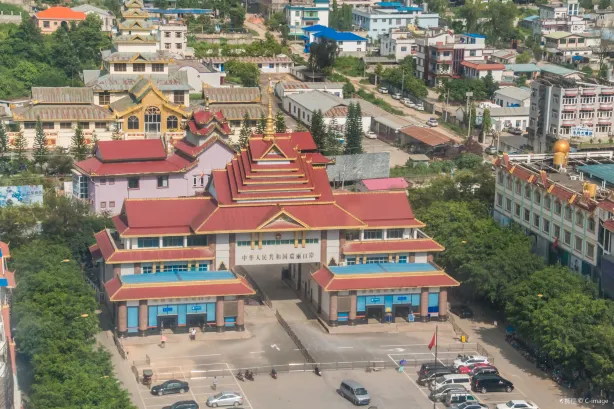
Jiegao Port is located on the east bank of the Ruili River, facing the Ruili city area across the river. It borders Muse, Myanmar, on the east, south, and north, serving as a busy land route for people and goods on the China-Myanmar border. "Jiegao" means "old city" in the Dai language and is said to have been the site of the ancient Mengmao city. Because it is surrounded by Myanmar on three sides and faces the river on one, it long functioned as an exclave. In the past, access relied entirely on ferries until the Jiegao Bridge was completed and opened to traffic in 1989, truly connecting the two sides. In 2005, a 600 m long, 4-lane bridge was opened, further easing traffic pressure. Jiegao Port implements a special inside the border, outside the customs management system: while located within the national border, the customs supervision line is set on the cross-river bridge, which gives this area a particularly strong atmosphere of border trade. The impressive national gate architecture and the straight, wide National Gate Avenue are the face of Jiegao.The nearby China-Myanmar Street is even more interesting. This street spans both countries; the Chinese side is called China-Myanmar Friendship Street, and the Myanmar side is called White Elephant Street,the boundary marker stands by the street, and standing in the middle of the street, you can see the streetscapes of two different countries on either side.

Ruili · 24.7km from Longchuan
Free attraction
Mangling One-Tree Forest
No. 4 of Best Things to Do in Ruili

Mangling One-Tree Forest

5.4
4.2/5
249 reviews

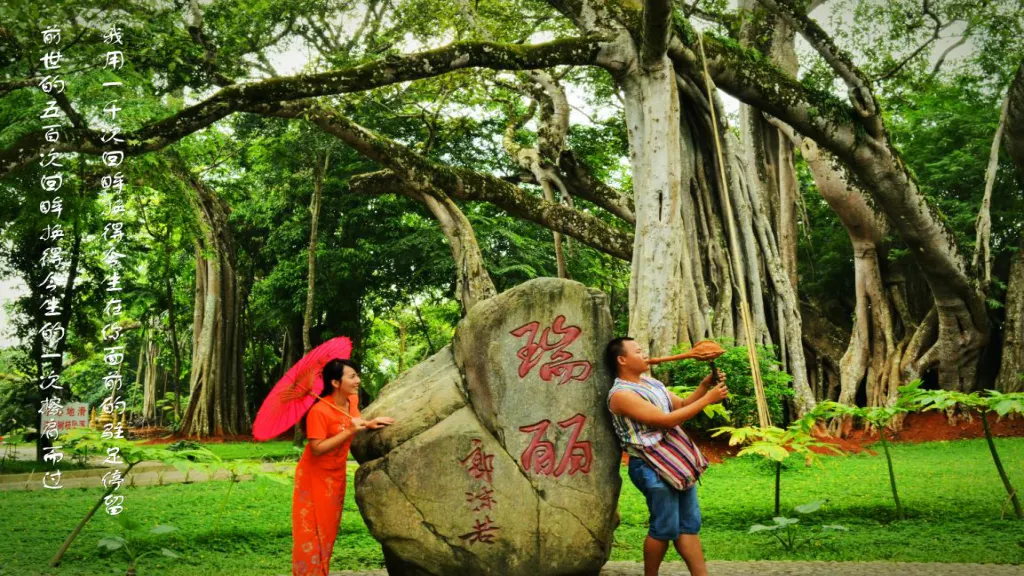
On the edge of the rainforest southwest of Ruili, a century-old banyan tree has woven a hidden ecological theater with its aerial roots. This forest community, naturally propagated from a single banyan, spans nearly four acres under its umbrella-like canopy. The aerial roots cascade like curtains, rooting into pillars upon reaching the ground, creating a multi-layered green corridor known as the Mangling Single-Tree Forest. Step into the forest as the morning mist lingers, where the scent of damp foliage drifts beneath a canopy of tangled vines. Sunlight filters through the leaves, casting dappled patterns on the interlaced "tree walls" of buttress roots, revealing squirrels darting along branches with wild fruits. Local Dai seniors often sit on the gnarled roots weaving bamboo crafts, occasionally sharing in their native tongue the legend of "Pahan Xiu" (tree spirits) guarding the village. If you stand quietly, you might hear the soft pecking of yellow-rumped sunbirds feasting on figs or the faint snap of an aerial root taking hold in the soil. In the afternoon, follow the wooden boardwalk deep into the shaded forest to discover a miniature ecosystem of ferns and orchids hidden beneath natural arches formed by aerial roots. During the rainy season, staghorn ferns clinging to branches unfurl new leaves, resembling a flock of suspended green butterflies. Locals set up bamboo tables in forest clearings, offering energy-boosting treats like water-splashing rice cakes wrapped in banana leaves and spicy pickled papaya for explorers to enjoy. As the setting sun gilds the aerial roots, the entire banyan grove transforms into a maze of light and shadow. Flocks of birds returning to their nests skim the treetops, startling a few banyan leaves that drift down onto the small altars dedicated to tree spirits among the woods—here you'll find no grand landscaping projects, yet every hanging aerial root writes primitive verses of rainforest life.

Ruili · 22.3km from Longchuan
Ruili Zongfo Temple

Ruili Zongfo Temple

5.2
4.8/5
6 reviews

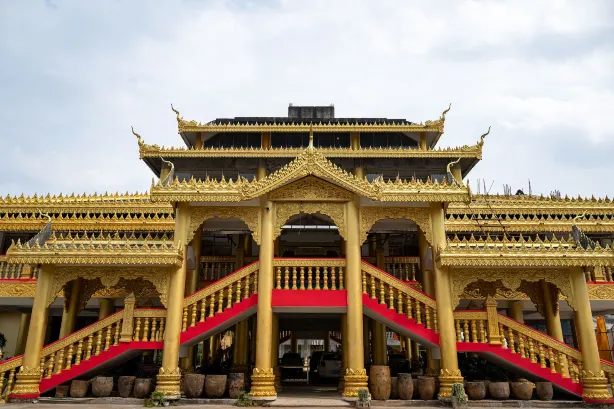
Ruili Zongfo Temple is located on the hillside of Guanghehan on the north bank of theRuili River, facing Muse, Myanmar, across the river. It is a Theravada Buddhist temple, known in the Dai language as "Wa Ba Jie." Today, it serves as a place for local believers to worship and pray, as well as a Buddhist study center for monks to study scriptures, and it also houses the Dehong Branch of the Yunnan Buddhist College. The temple's architecture blends traditional Dai styles with the styles of Buddhist temples in Southeast Asia, such as those in Myanmar and Thailand: the main hall with its triple-eave hip-and-gable roof is covered with a golden roof, while the red-painted and gold-traced stone pillars, intricately carved window lattices, and wooden brackets are full of exotic charm. The golden pagoda on the hilltop shines brightly in the sunlight. Inside the temple, there is a giant hollow Buddha statue 7.9m high, composed of hollowed-out elements such as the Dharma wheel, lotus flowers, and golden Buddhas. At sunset on a clear day, the afterglow passes through the hollow parts and shines on the Buddha, presenting a spectacular scene of "heaven and Buddha as one." Standing on the hilltop viewing platform, you can look out over the Ruili urban area on one side and Muse, Myanmar, on the other side of the river, truly experiencing the border scenery of "one basin, two countries." The temple is also adjacent to theDai King Palace, which you can visit along the way.

Ruili · 21.8km from Longchuan
Free attraction
Jiele Pagoda

Jiele Pagoda

4.4
4.5/5
44 reviews

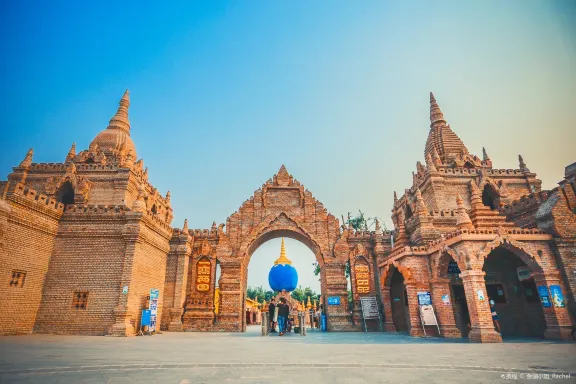
Jiele Pagoda, known in the Dai language as "Guangmu Hemao," meaning "the pagoda at the head of the Ruili Basin," is an ancient Buddhist structure and a site for Theravada Buddhist activities in Ruili, as well as one of the famous pagodas in Southeast Asia. Legend has it that it was first built in the 17th century. Throughout history, it has been destroyed and rebuilt many times. The existing golden pagoda was rebuilt on the original site in the 1980s. The entire pagoda complex consists of 17 solid brick pagodas and is made of reinforced concrete. The main pagoda is nearly 40 m high, shaped like a regular octagonal cone, and covered with golden ceramic tiles. The main pagoda is surrounded by 16 smaller pagodas of large, medium, and small sizes, rising in tiers. The pagoda bodies are coated with gold powder, appearing magnificent from a distance, like stars surrounding the moon. The pagoda base is built with rectangular bluestone, and the circular foundation has a diameter of approx. 30 m. The top of the pagoda is adorned with a precious umbrella and a wind vane, with hundreds of wind chimes attached. When a breeze blows, the chimes ring melodiously. The main pagoda is nestled among a cluster of banyan trees, possessing distinct Dai architectural features. A Buddhist temple is built next to the pagoda. During the annual Water-Sprinkling Festival, grand pagoda-worship ceremonies are held here, where local Dai devotees come to worship, chant, and offer sacrifices, creating a lively scene.

Ruili · 20.3km from Longchuan
Free attraction
Bianzhai Hansha Tourism Scenic Area

Bianzhai Hansha Tourism Scenic Area

4.6
4.3/5
61 reviews

Bianzhai Hansha Tourism Scenic Area is located in Hansha Village, Mengmao Town, Ruili City, and is a border village with Dai ethnic folk culture at its core. In the village, bamboo houses are nestled among phoenix-tail bamboo and banyan tree clusters, surrounded by fields, preserving the rustic style of a traditional Dai village. Hansha is an important center for the inheritance of the Dai peacock dance. The village has a peacock dance learning center where folk artists often perform authentic peacock dances. Dancers follow the rhythm of elephant-foot drums to imitate the postures of a peacock spreading its tail, drinking water, and strolling, making it a great place to experience Dai dance culture. The walls along the village roads are painted with colorful murals depicting Dai life customs, farming activities, and Buddhist stories. Known as "peasant paintings," they add a unique artistic atmosphere to the village. The Hansha Temple within the village was built in the late Qing Dynasty. It is a Theravada Buddhist temple that features Dai stilt-house architecture. A golden pagoda stands in the temple, and when a breeze blows, the wind chimes on the pagoda ring crisply. Water Splashing Plaza is the main venue for Water-Splashing Festival activities in the village. During the Dai New Year, villagers dress in festive attire and splash water on each other to exchange blessings, and even on ordinary days, you can feel the rich atmosphere of Dai festival culture.

Ruili · 23.4km from Longchuan
Free attraction
Longchuan Today's weatherClear 7-24℃
Longchuan weather for the next 2 days11/30: 6-23℃, 12/1: 8-23℃

Free things to do in Longchuan

What travellers say about Longchuan

user-avatar
_We***837 November 2026
5.0
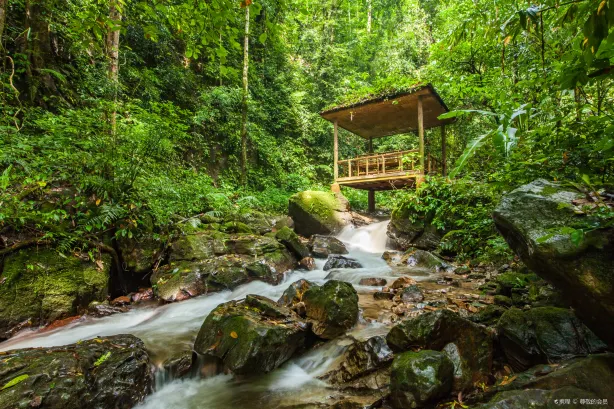
A natural rainforest oxygen bar, the round trip is gentle and not tiring, suitable for all ages. Along the way, you'll be accompanied by streams and ancient trees, culminating in the spectacular Moli Waterfall at the end, with its misty atmosphere creating a fantastic photo opportunity. It's great value for money and definitely worth a visit to cleanse your lungs and relax. Remember to wear non-slip shoes, as the path is quite slippery.

Moli Tropical Rainforest Scenic Area

user-avatar
小旭091324 October 2026
5.0
Emmmm, well, it's not worth coming all the way to Ruili because of it. You don't necessarily have to come here to experience the local customs and culture. It's not very interesting. It's just for taking pictures and checking in!

One Village, Two Countries

user-avatar
大 牛28 August 2026
5.0
It was free to enter. I walked. The Jiegao Bridge is very long, and Jiegao is right on the other side of the river, which is quite interesting because most national borders are defined by rivers, but Jiegao is like an exclave. The border gate also has a distinctive ethnic style. Climbing to the rooftop next to it, you can see the buildings on the other side, which are all quite similar.

Jiegao Port

user-avatar
喜欢猫的虎17 January 2021
5.0
This tree is next to Mangling Village (next to National Highway 320). From a distance, it looks like a green forest. If you look closely, you can find that this forest is actually just a banyan tree. Ruili people call it the Welcoming Banyan Tree. This Welcoming Banyan Tree is not very big. It ranks fifth in Dehong Prefecture, but it has a unique tree shape and changes its posture from left to right, front to back, so it is favored by many film and television experts. For example, more than ten films and TV series such as "Border Village Fire", "Peacock Princess", "Traveler with Handcuffs", and "Journey to the West" have been filmed here. The famous movie star Wang Xiaotang has played on the swing on this tree, and Liu Xiaoqing lingered in the forest.

Mangling One-Tree Forest

user-avatar
弘扬师兄27 July 2025
4.0
Ruili General Buddhist Temple and Dai Palace are located next to Panbeng Village in Mengmao Town, Ruili City, Yunnan Province, on a high slope 8 kilometers away from Ruili City. The two attractions are adjacent to each other. For those who come to Ruili in autumn and winter, especially those who have faith, this is a good place with pleasant scenery, quiet and peaceful. It is a good idea to stay for a while or to camp the RV here. Don't underestimate this place. The General Buddhist Temple has a host and monks, and a group of young monks are being cultivated in the temple; the General Buddhist Temple is very popular, and there are endless tourists visiting. From time to time, there are tour groups visiting this temple. The hollow Buddha statue is a great place to take pictures of the sunset; the building is grand and magnificent, splendid, and the infrastructure is complete. The Dai Palace is about 20 meters away from the General Buddhist Temple and covers an area of about 533 acres. The buildings include the Dai Palace, the Great Pagoda, the dining area, the palace ruins, the wash well ruins, the wash elephant pool ruins, the training ground ruins, etc. I don't know why the Dai Palace's facilities are not as good as those of the main Buddhist temple. There are no monks, no incense, no tour groups, only sporadic individual tourists. The reason may be that the infrastructure needs to be improved, the staffing is not in place, etc. However, this is also a good place to take pictures of the sunset.

Ruili Zongfo Temple

user-avatar
pekingwang3 January 2021
5.0
The Dai Palace is all Thai-style architecture. You can pretend to be in Thailand. I can't go abroad, but coming here is like going abroad. It's still Thailand without tourists [snickering], with more quietness and less noise.

Dai King Palace

user-avatar
秋风知我意~17 May 2025
4.0
瑞丽古城虽是商业化新建的文旅综合体,但这里吃、住、闲都很丰富,有休闲度假的温泉酒店,有流连忘返的咖啡酒馆,还有味道正宗、环境优美的餐饮商家。不论你是外地游客还是本地居民,还是很值得来走走逛逛玩玩的。

Ruili Ancient City

user-avatar
哈哈岛张易之30 March 2020
5.0
Jielejin Pagoda, called "Guangmu Hemao" in Dai language, means the pagoda in the horse head of the dam. It is 5 kilometers northeast of Ruili City, Yunnan Province. It is the oldest Buddhist building and Buddhist activity site in Ruili. You can take bus No. 5 from the city or take a taxi, the fare is about 15 yuan.

Jiele Pagoda

user-avatar
M34***301 May 2026
5.0
The houses are beautiful and have ethnic characteristics; the villagers must be very happy.

Bianzhai Hansha Tourism Scenic Area

Popular cities near Longchuan

Frequently asked questions

How can I contact Trip.com customer support?

Get help anytime, anywhere within 30 secondsContact customer support

Change and cancellation policies vary by attractions and tours. Please check the product details page for more information.

Ticket prices may vary between weekdays and weekends, as well as during peak and off-peak seasons. When booking with Trip.com, you can also use Trip Coins to get extra savings. For more tips on booking discounted tickets, please visit Trip.com for the latest information.