How to Choose China Train Seats? Classes, Seat Maps & Amenities

By Bethy
October 28, 2026

China train seat classes and seat maps explained: which letters are window or aisle, second vs first vs business class, sleeper berths, and how to pick a seat on 12306 or Trip.com.
🚄 [Coupon] Trip.com China Train Promo Codes
Unlock discounts on China train tickets on Trip.com! Use this promo code at checkout for instant savings on your China rail journey.
China Train Types: What G, D, C, K, T and Z Mean
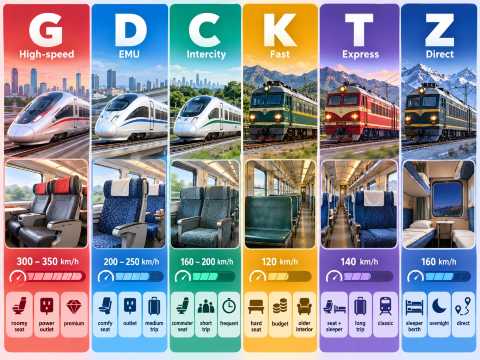
The letter in a train number tells you what kind of train it is and roughly how fast it goes. The letters split into two groups: the EMU trains, which power every carriage, and the conventional trains, which are pulled by a locomotive.
Letter | Type | Top speed | What it is for |
|---|---|---|---|
G | High-speed EMU | 300–350 km/h | Long-distance high-speed, fewest stops, priciest |
D | EMU | 200–250 km/h | Best value, runs on high-speed and upgraded lines; overnight D sleepers |
C | Intercity EMU | 160–350 km/h | Short hops between nearby cities, high frequency |
Z | Direct express | 160 km/h | Conventional long-distance with few stops |
T | Express | 140 km/h | Conventional, stops at major stations |
K | Fast | 120 km/h | The most widespread conventional train, most stops, cheapest |
There is also a subtlety people argue about: strictly speaking, 高铁 is the railway itself and 动车 is the train, so G, D and C are all 动车组 trains. In everyday speech, G is called "high-speed rail" and D is called "bullet train", but they are the same family of trains running at different speeds.
The overnight sleepers are their own thing. The D-series 动卧 sleepers run through the night between major cities, with a soft-sleeper-style compartment in first class and a quieter hard-sleeper-style berth with charging in second. They save a hotel night and a day of travel, which is why they are popular despite the price.
China Train Seat Classes at a Glance
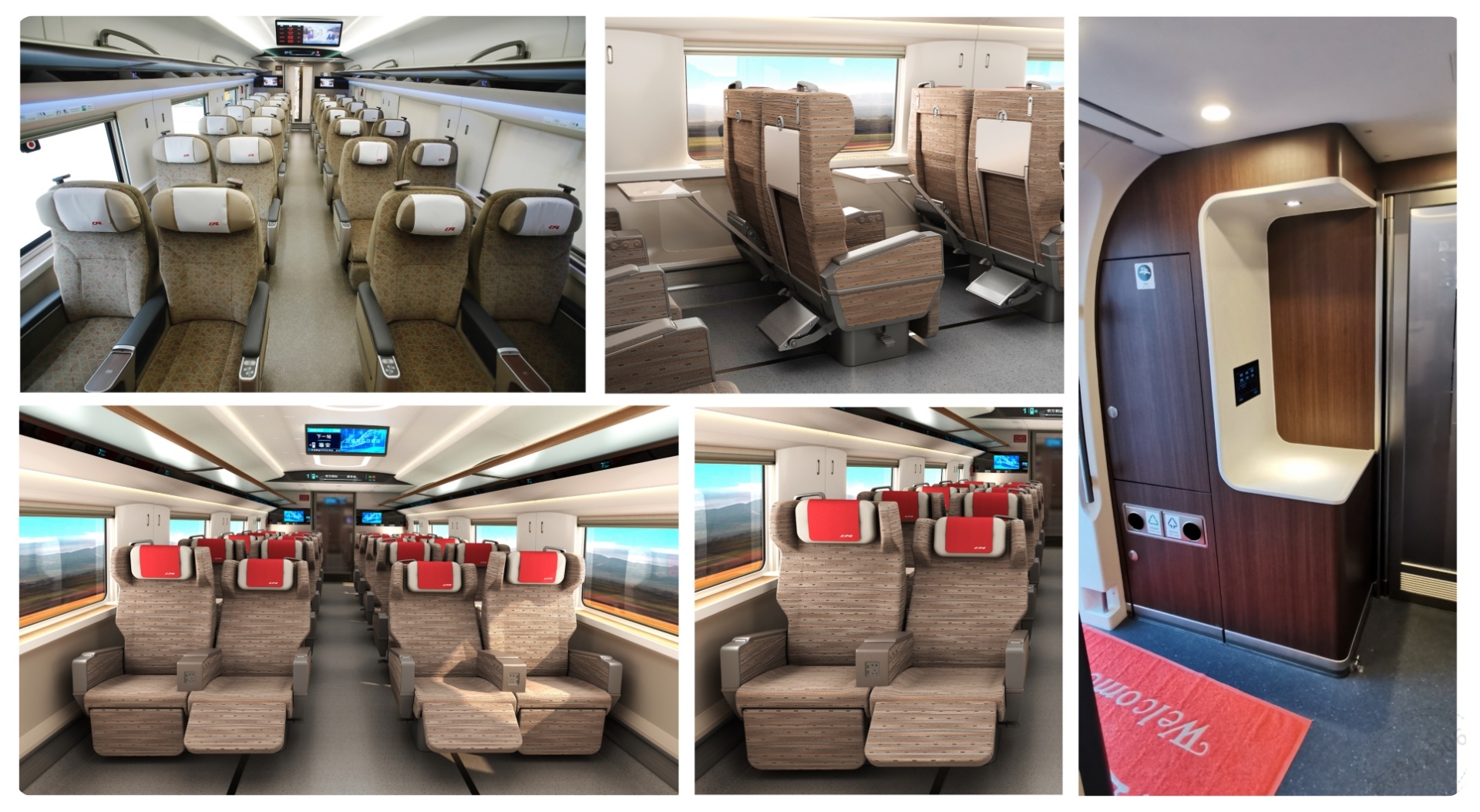
First class (一等座)
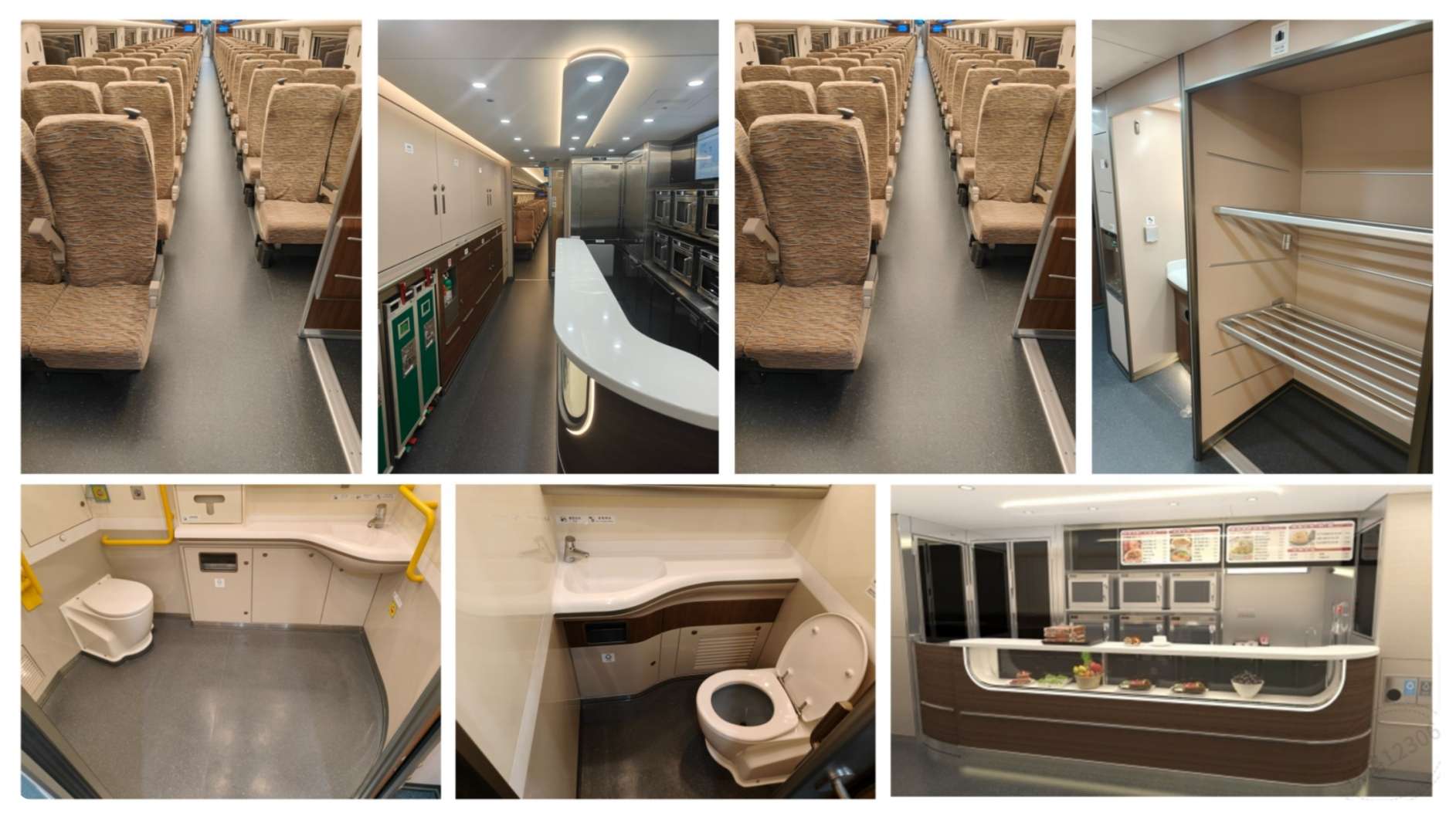
Second class (二等座)
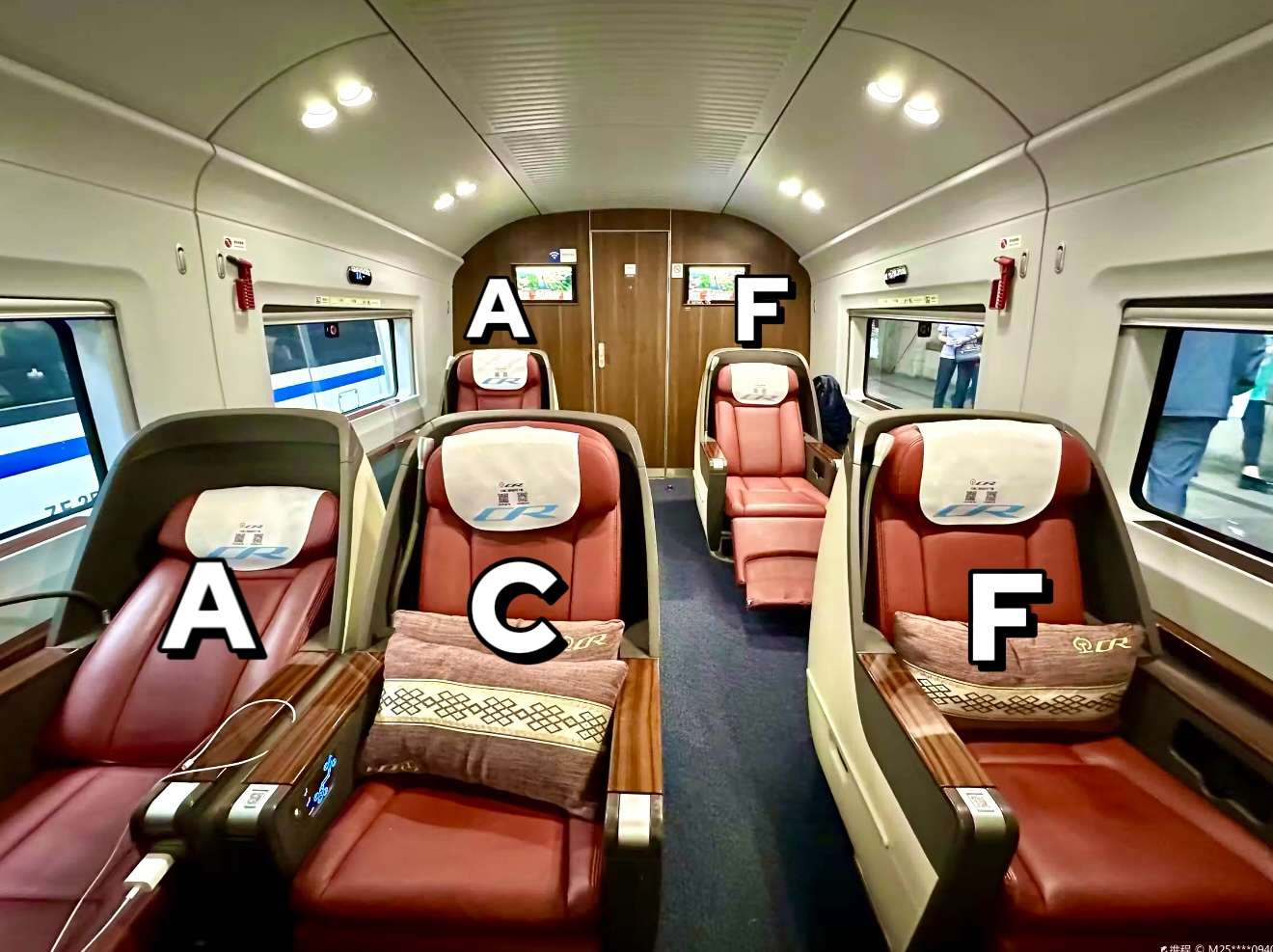
Business class (商务座)

Hard seat (硬座)

Soft sleeper (软卧)

Hard sleeper (硬卧)
Class | Train types | Layout | What you get |
|---|---|---|---|
Second class (二等座) | G, D, C | 3 + 2, five seats a row | The standard, cheapest high-speed seat |
First class (一等座) | G, D, C | 2 + 2, four seats a row | Wider seats, more legroom |
Business class (商务座) | G, D, C | 2 + 1 or 1 + 1 | Lie-flat or reclining seats, meals on many trains |
Hard seat (硬座) | K, T, Z | 3 + 2 | The cheapest conventional seat |
Soft seat (软座) | K, T, Z | 2 + 2 | Padded conventional seat |
Hard sleeper (硬卧) | K, T, Z, some D | Six berths in an open bay | The standard overnight berth |
Soft sleeper (软卧) | K, T, Z, D sleepers | Four berths in a closed compartment | More privacy, wider berth |
Standing (无座) | Any | None | A ticket without a seat |
To Beijing
To Shanghai
To Guangzhou
See all flights


China Train Seat Map & Letter System (Window or Aisle)
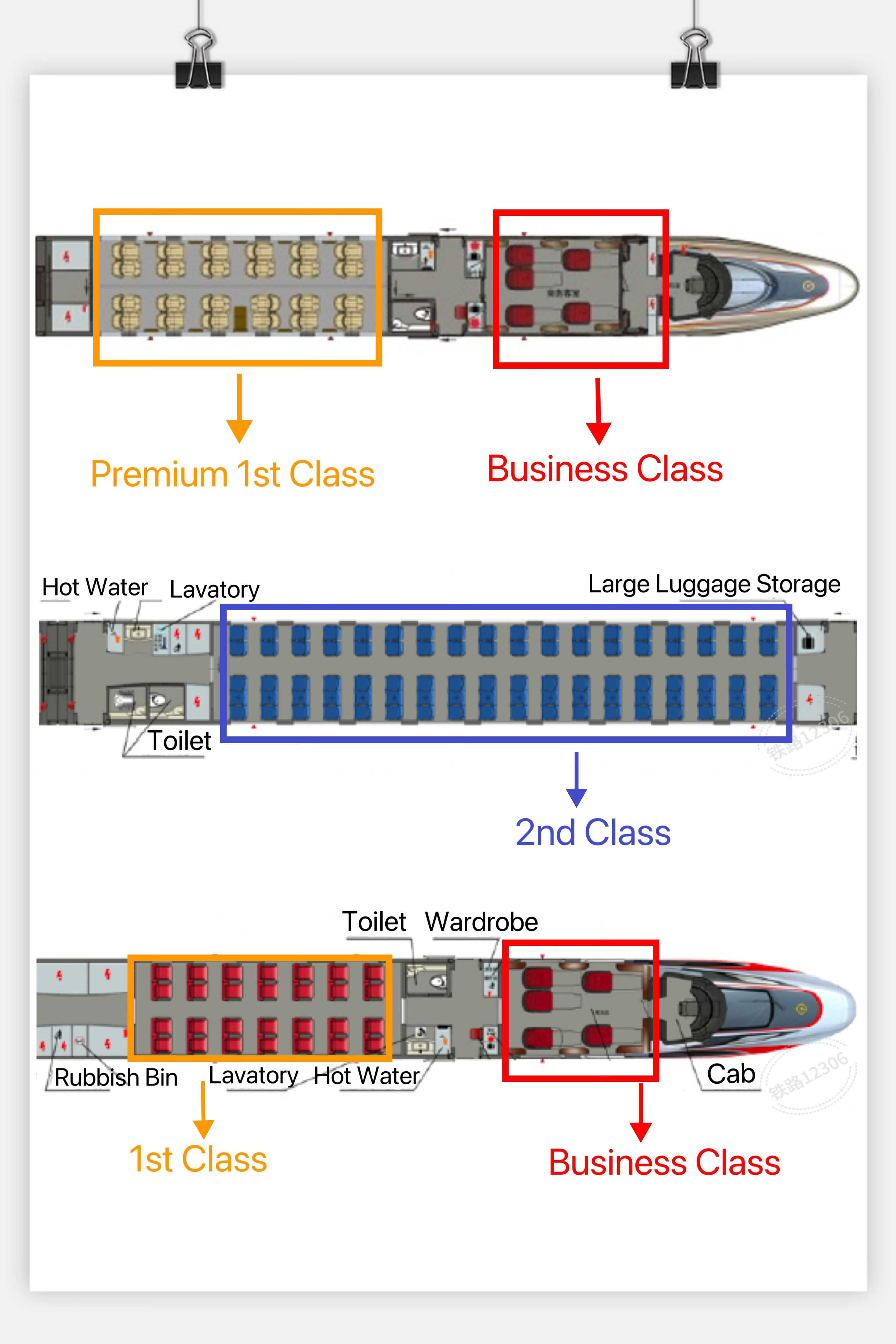
Chinese train seat numbers are easy once you learn the letter code: A and F are always window seats, C and D are always aisle seats, and B is the middle seat in second class. There is no E, and once you know that, you can read any seat number at a glance and pick the one you actually want.
- A and F: window
- C and D: aisle
- B: middle (second class only)
There is no E. China kept the aircraft convention where A and F are windows and C and D are aisles, and because a second-class row has only five seats, it dropped the E from the middle pair and kept only B. So a five-seat row reads A, B, C on one side and D, F on the other.
China Train Second class seat map (3 + 2)

China Train Second class seat map (3 + 2) Source from The China Gude
Seat | Position |
|---|---|
A | Window |
B | Middle |
C | Aisle |
D | Aisle |
F | Window |
The F side is the two-seat side, which is why F is the slightly better window seat: you are next to one person instead of two.
China Train First class seat map (2 + 2)

China Train First class seat map (2 + 2) Source from China Train Guide
Seat | Position |
|---|---|
A | Window |
C | Aisle |
D | Aisle |
F | Window |
No B and no middle seat, because there is no three-seat side.
China Train Business class seat map (2 + 1)

Business class seat map (2 + 1) Source from Unsplash
Seat | Position |
|---|---|
A | Window |
C | Aisle |
F | Window |
Business class has a two-seat side and a single seat, and the F is the single. On trains with a 1 + 1 layout, the letters are just A and F, both window seats.
See all attractions
 999089 booked





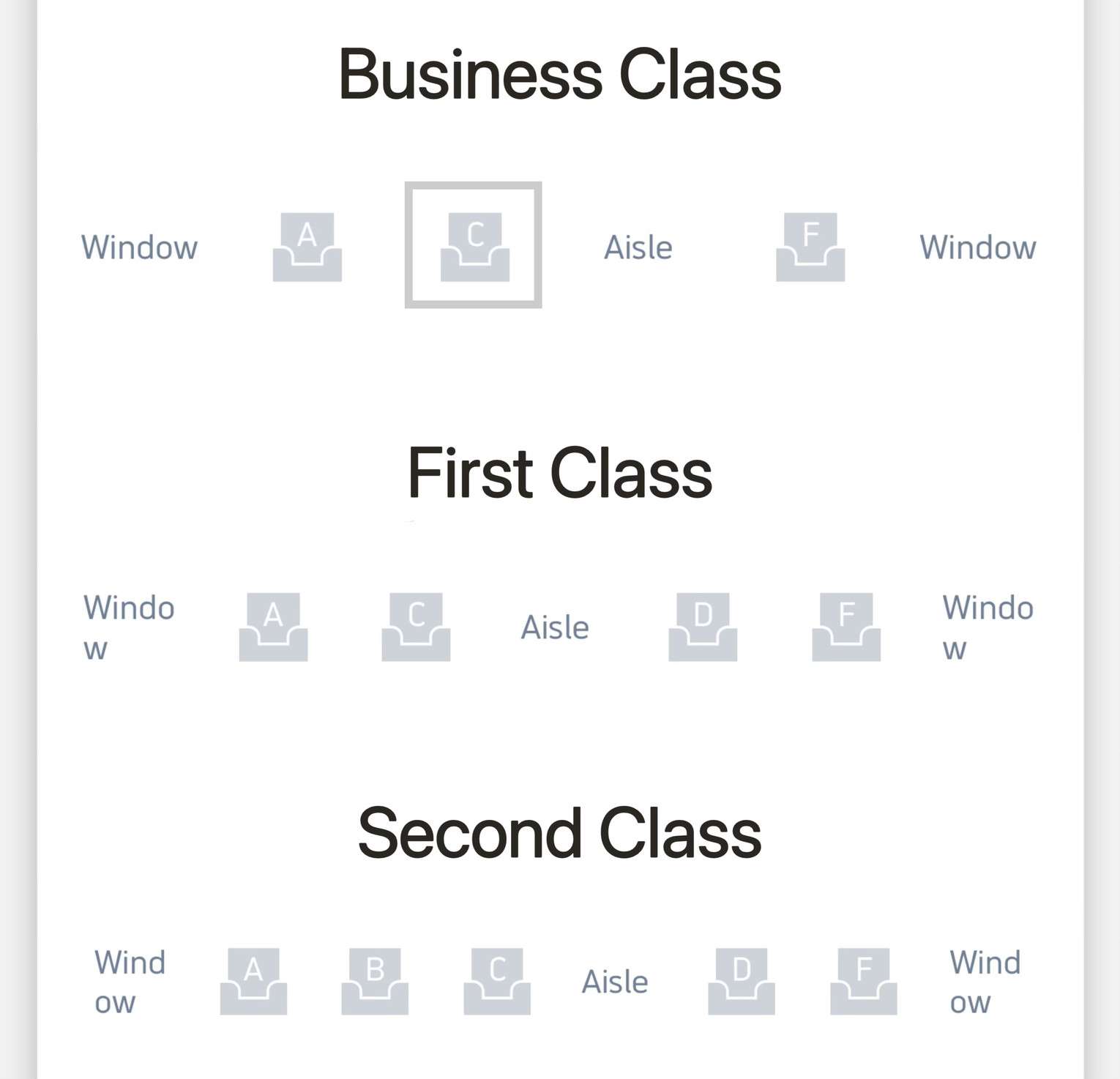
China Train Second Class vs First Class vs Business Class Seat
Second class | First class | Business class | |
|---|---|---|---|
Seats per row | 5 | 4 | 2 or 3 |
Seat width | Standard | Wider | Widest |
Legroom | Standard | More | Most |
Recline | Limited | Good | Near-flat or lie-flat |
Extras | None | Power socket, more space | Meals on many trains, lounge access at some stations |
Price | Cheapest | Roughly 1.5 to 2 times second | Several times second |
For a trip under two or three hours, second class is fine. First class is worth it for legroom on longer runs or when you need to work. Business class is a different product entirely, closer to a lie-flat seat on a plane, and priced accordingly.
China Train Sleeper Berths: Hard Sleeper vs Soft Sleeper
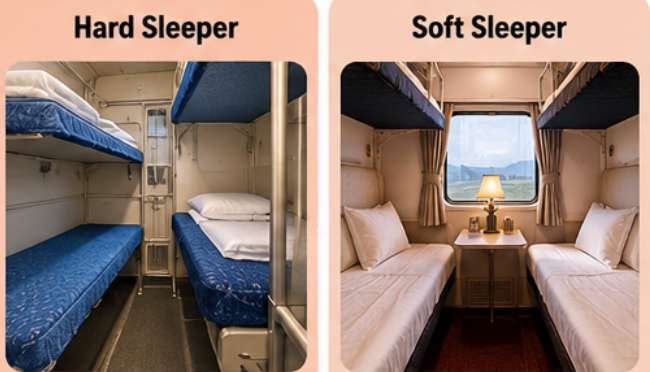
Overnight trains sell berths rather than seats, and the two main types are not just a comfort difference.
Hard sleeper (硬卧) is six berths in an open bay with no door, stacked in three tiers: lower, middle and upper. The lower berth is the easiest to get in and out of, and the most expensive of the three. The upper is the cheapest and the least private. There is no seat selection, but you choose a berth preference when booking.
Soft sleeper (软卧) is four berths in a compartment with a door, in two tiers: lower and upper. It is wider, more private, and notably more expensive than hard sleeper. For two people who want privacy, a soft-sleeper compartment is the comfortable choice.
On high-speed overnight trains (the D-series sleepers), the same soft-sleeper compartment layout applies, and there is a deluxe option with only two berths on some trains.
Can You Get a Lower Berth, or Seats Together?
Two common requests, and how the system handles them.
Lower berths. You can request a lower berth when booking a sleeper, and the system honours it while stock lasts. Passengers aged 60 and over get an automatic lower-berth priority, based on the date of birth on their ID, even if nobody selected a berth. That priority is not a guarantee when the lowers are gone, and the lower berth costs more than the middle or upper.
Sitting together. To get adjacent seats, book everyone in a single order rather than separate ones. Two people fit naturally as D and F in second class, or A and C, or D and F, in first class. Three people together is A, B and C in second class.
How to Choose a China Train Seat on Trip.com
Trip.com lets you state a seat preference, but it is a request, not a guarantee, because the actual assignment happens in the 12306 system.
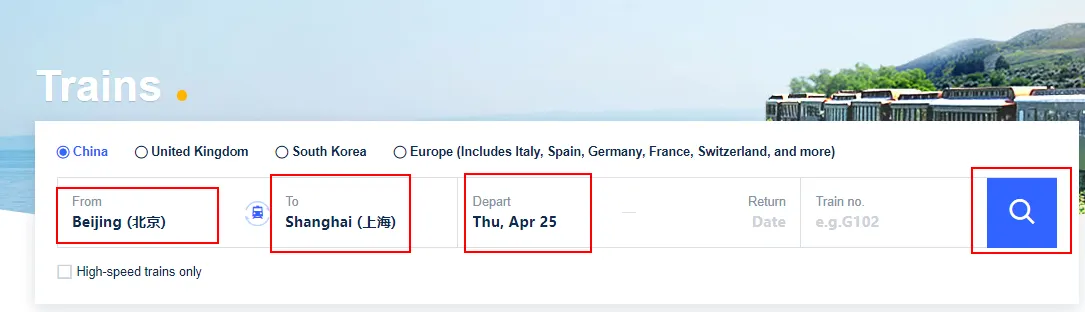
- At checkout, choose a preference such as window or aisle, or sit-together.
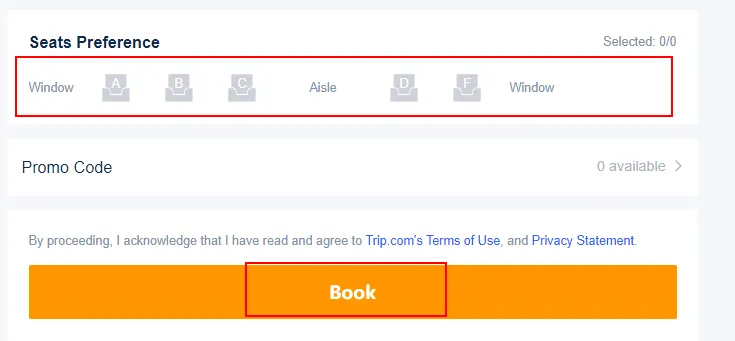
- Trip.com passes that preference to 12306 when it books the ticket.
- If a matching seat is available, you get it. If the train is nearly full, you get the next best seat instead.
- If you book a pre-order before the 15-day sales window opens, the preference is queued and applied when tickets go on sale.
The practical rule is the same on both platforms: the only way to guarantee the seat is to book early, and the only place to pick an exact letter is 12306 itself.
How to Choose a China Train Seat on 12306
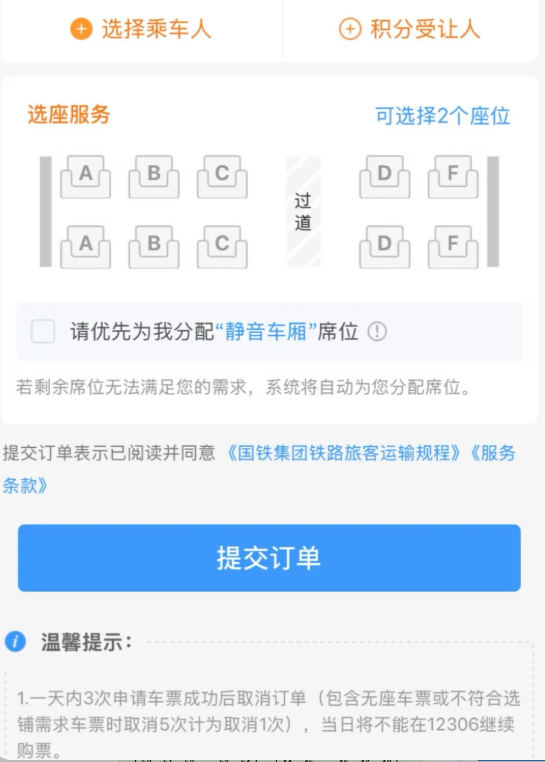
12306 is the only place where you choose an exact seat, and it works for high-speed trains but not for the letterless conventional ones.
- On a G, D or C train, when you reach the order page after selecting passengers, a seat panel appears with the letters A, B, C, D and F.
- Pick the letter you want for each passenger, such as A or F for a window, or D and F to sit together.
- If the seat you chose has already gone, the system assigns whatever is left, so the earlier you book, the more likely your choice sticks.
- For K, T and Z sleepers, you choose a berth preference instead: lower, middle or upper for hard sleeper, lower or upper for soft sleeper.
One rule that saves a lot of frustration: once a ticket is issued, you cannot change the seat. If you do not like where you ended up, the options are to change the ticket to another train or cancel and rebook, both of which come with conditions.
The Service Icons Next to China Train Numbers: 雪, 宠, 兑, 静 and 铺
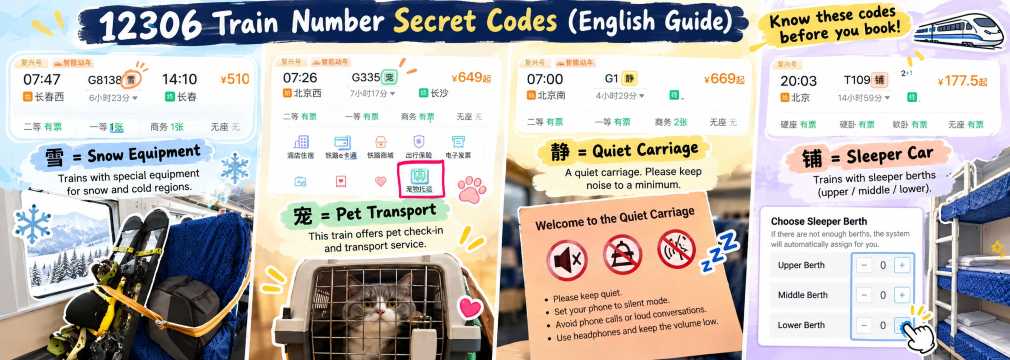
Next to some train numbers on 12306 there are small character tags, and each one is a service code rather than decoration. They mark trains that carry a specific feature, and knowing them lets you pick a train for more than just its departure time.
Icon | Meaning | Who it is for |
|---|---|---|
雪 | Ski equipment service | Skiers carrying boards |
宠 | Pet consignment | Travellers with a cat or dog |
兑 | Points redemption | 铁路畅行 members |
静 | Quiet carriage | Anyone who wants a silent ride |
铺 | Berth selection | Overnight travellers |
雪: the ski equipment service
On some winter routes, mostly in the north-east, trains run a "ski equipment convenience" service that lets you bring your skis or board on the same train as you instead of checking them as freight. The total of length, width and height must not exceed 200 cm, and the gear must be packed properly.
After you buy your ticket, select the ski service in the app, enter the details and pay. It costs about ¥98 per set, with some lines running a cheaper ¥68 promotion. The gear goes in a dedicated storage area in the carriage, and you can download the invoice within 180 days of the trip.
宠: pet consignment
The 宠 tag means the train can carry a pet, but not the way most people hope. This is consignment, not bringing a pet into the cabin.
It covers cats and dogs only, up to two animals, each no more than 15 kg, with shoulder height up to 40 cm and body length up to 52 cm. The animal travels in a ventilated box in a designated cabinet, separate from you, and you cannot visit it during the ride. You need a valid animal quarantine certificate, and you book the service through the 12306 pet consignment entry, after which the review result is confirmed by text message. It is charged by distance and includes a basic ¥2,000 insurance policy. If you want to travel with a pet, this is the honest summary of what the railway offers.
兑: points redemption
This tag means the train accepts 铁路畅行 loyalty points as full payment for a ticket. Points convert at 100 points to ¥1, and the first redemption requires having built up at least 10,000 points.
The earning rate depends on age: ordinary members earn 5 times the fare, members aged 14 to 28 earn 10 times, and members 60 and over earn 15 times, with student tickets staying at the base 5 times. Points can also be used to upgrade a seat, and you can redeem for up to eight other people, though each recipient takes 60 days to activate. Point tickets cannot be refunded and allow one change.
静: the quiet carriage
Since 1 February 2026, quiet carriages have been available on most G and D trains except the sleepers, more than 8,000 services in total. Book one by ticking the option to be assigned to a quiet carriage, which also means no standing tickets are sold there.
The rules are simple and enforced by the other passengers as much as the staff: phones on silent or vibration, headphones for anything with sound, and conversations or calls taken outside the carriage. Earplugs are available from the crew if you ask, but the official advice is to bring your own.
铺: berth selection
The 铺 tag simply marks a sleeper train where you can pick your own berth, lower, middle or upper, instead of accepting whatever is assigned. Passengers aged 60 and over get an automatic lower-berth priority, and if you do not choose, the system assigns one for you. Once the ticket is issued, the berth list appears under the passenger, and the rules for lower berths and sitting together are the same as elsewhere in this guide.
Facilities on Chinese Trains
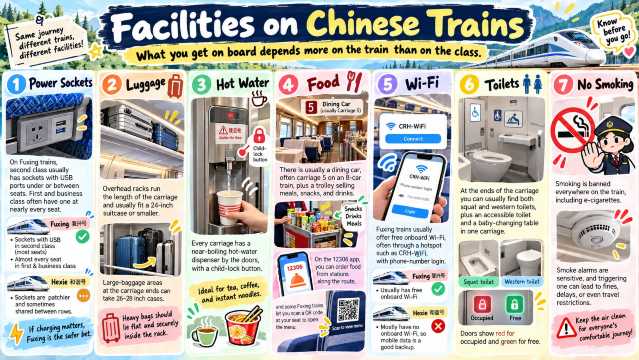
What you get on board depends more on the train than on the class, and it is worth knowing before a long trip.
- Power sockets. On 复兴号 trains, second class has sockets with USB ports under or between the seats, and first and business class have one at nearly every seat. On the older 和谐号 trains, sockets are patchier and sometimes shared between rows. If charging matters, a 复兴号 train is the safer bet.
- Luggage. There are overhead racks the length of the carriage, which suit a 24-inch case or smaller, and a large-baggage area at the carriage ends for 26 to 28-inch suitcases. Heavy bags should lie flat and inside the rack, not teetering on the edge.
- Hot water. Every carriage has a hot-water dispenser by the doors, at near-boiling temperature, with a child-lock button. It is there for instant noodles and tea, and it is why half the carriage eats noodles at some point on every long trip.
- Food. There is a dining car, usually carriage 5 on an eight-car train, selling boxed meals, snacks and drinks, and a trolley that passes through. On the 12306 app you can also order food from stations along the route and have it delivered to your seat, and on some 复兴号 trains a QR code on the seat or tray opens the menu directly.
- WiFi. 复兴号 trains have free onboard WiFi, usually a hotspot with a name like CRH-WiFi, which asks for a phone number to log in. 和谐号 trains mostly have none, so plan on your own mobile data.
- Toilets. Both squat and western toilets sit at the carriage ends, with an accessible toilet and baby table in one carriage. There is an SOS button inside, which is worth not pressing by mistake, and the door shows red for occupied and green for free.
- Smoking. Banned on every train, everywhere, including e-cigarettes. The smoke alarms are sensitive, and triggering one can slow or stop the train, with fines and a travel blacklist to follow.
Tips for Getting the Seat You Want
- Memorise the code: A and F are window, C and D are aisle, B is middle.
- Book early, because seat choice fails when the train fills up, not because the system is unfair.
- Pick F for a window with fewer neighbours, since it is the two-seat side.
- Book everyone in one order to sit together.
- Do not plan to swap seats after boarding unless the other passenger agrees, since the seat on your ticket is the seat the train crew recognise as yours.
- For a lower berth as a senior traveller, the priority happens automatically, but booking early still helps when the train is full.
🔥[Discount] China Hotel Recommendations
Top Shanghai Hotels
Top Beijing Hotels
Top Guangzhou Hotels
See All Hotels





FAQs About China Train Seats
-
Which seat letters are window seats in China?
-
What do G, D, C, K, T and Z mean?
-
What is the seat layout map of Chinese high-speed trains?
-
Do Chinese trains have power sockets and WiFi?
-
How do I choose a window seat on 12306?
-
What is the difference between China hard sleeper and soft sleeper?
-
Can I change my China train seat after booking?
Disclaimer: This article has been provided by an individual contributor or third party platform. If there is any discrepancy regarding the copyright, please contact us directly and we will delete the content immediately.
Trending Searches
-
Popular Cities