How to Pack a Suitcase: Best Techniques & Tips

Travelling soon but wondering how to pack a suitcase? Well, the easiest way to pack a suitcase is to pack less, organise what you take, and place every item where it makes sense. Essentially, the key to filling a suitcase is to think rationally. Pack what's necessary. Be purposeful. However, precisely, how do you do that? Let's understand it in this blog that provides a step-by-step guide to packing your bags.
to Bangkok
to Manila
to Shanghai
to Tokyo
to Seoul
See all flights


Choose the Right Suitcase for Your Trip
Note: AI-generated image. Only for reference.🎁 Book Cheapest Flights Worldwide | Search Best Hotels | Get fast & reliable eSIM.
Before you pack even a single item, choose the right bag. Selecting the right one helps you establish your physical boundaries, while preventing over-packing.
Next, ensure you choose a bag aligned with your travel duration and mobility needs. For example, select a bigger bag for longer stays.
However, that's with the size. What about the material and the type of bag? Let's find it out.
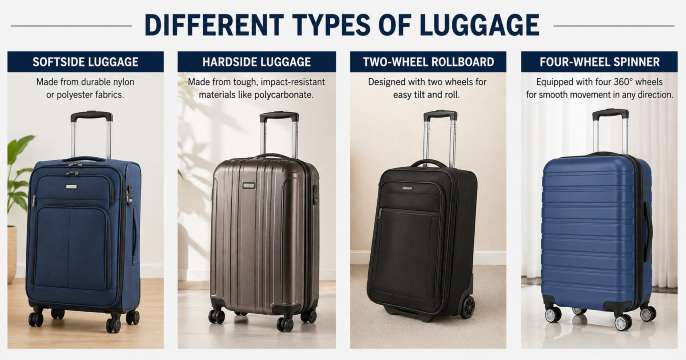
- Softside Luggage: Softside bags offer flexibility as they are made of durable nylon or polyester fabrics. They have external zippered pockets to provide quick access to travel documents. They can also flex slightly to fit heavier items. Hence, they are ideal if you prefer having extra exterior storage.
- Hardside Luggage: Not as flexible, yet these bags offer superior protection for fragile items. They are more water-resistant and as they are made of polycarbonate or ABS shells, they are structurally stronger. Suitcases like these are split into two equal halves. So, packing stays more structured and naturally balanced.
- Two-Wheel (Rollaboard) vs. Four-Wheel (Spinner): Spinners glide effortlessly on smooth airport floors, curbing strain on your wrists. Therefore, they are ideal for urban travel. On the other hand, two-wheel rollaboards perform better on cobblestones, gravel, and uneven sidewalks due to their larger, sturdier wheels.
Check Airline Baggage Limits and Excess Baggage Charges
Note: AI-generated image. Only for reference.
Imagine paying USD 100 or more before your journey even begins! That will surely sour your air travel experience faster than anything else.
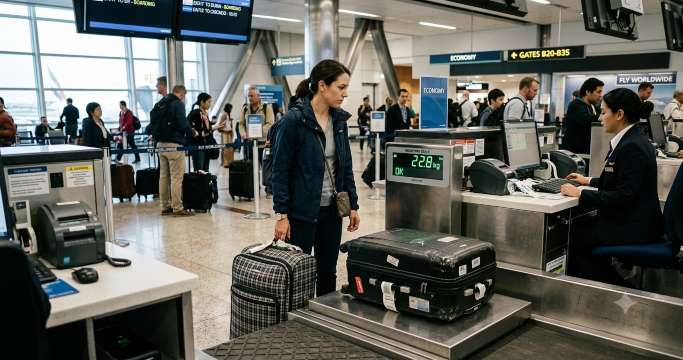
Often, travellers fill their suitcases without checking the airline baggage limit and excess baggage cost.
Each airline has a specific checked-in baggage limit based on the class of travel, fare paid, route, and carrier type.
Therefore, it is wise to check airline baggage limits to avoid inconveniences, arguments at the check-in counter and excess baggage cost.
Here's some generic information to airline luggage limits. However, please note baggage rules, terms, conditions and limits may vary with each airline. Hence, it is recommended to check the specific baggage limit mentioned in your itinerary.
Carrier/Airline Category | Typical Carry-On Weight | Typical Checked-In Baggage Weight |
Budget/Low-Cost Carrier | 7-10 kg (15-22 lbs) | 15-20 kg (33-44 lbs) |
Standard Full-Service Carriers | 8-12 kg (17-26 lbs) | 23 kg-30 kg (50-66 lbs) per bag |
International/Business Class | 12-15 kg (26-33 lbs) | 32 kg (70 lbs) or more per bag |
Note: We have created a comprehensive guide for airline baggage rules and limits. We hope it helps you.
See all attractions
 662141 booked

Create a Packing List Before Opening Your Suitcase
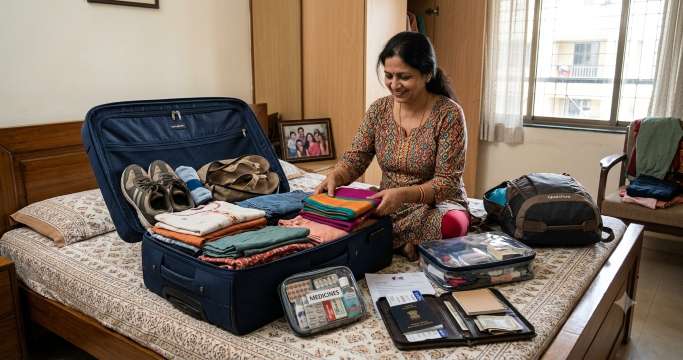
Note: AI-generated image. Only for reference.
Usually, people overpack before even assessing if really need something. Some carry the overpacked bag to face potential inconveniences at the airport. Many others realise they've overpacked the bag, only to remove items one-by-one, either at home, hotel or at the airport.
However, knowing what to carry before you zip and lock the bag can help prevent inconvenience.
Accordingly, you must divide your list into categories, including:
- Clothing
- Footwear
- Toiletries
- Electronics
- Documents
- Medicines
- Accessories
- Travel essentials
After that, consider your destination, its weather, activities you will perform and your trip duration.
Usually, while creating a list of items, many travellers pack different outfits for each day. This is understood while on an official trip. However, if you are travelling for tourism or personal reasons, you don't have to pack five different outfits for five different days. Instead, you must choose clothes you can combine in different ways.
For instance, you can pack three tops, or t-shirts and two pairs of trousers or jeans to have enough clothes without filling half your suitcase.
Note: Pack for your actual trip, not for the hypothetical situations that might happen.
Mastering Packing Techniques: Rolling, Folding and Bundling
Note: AI-generated image. Only for reference.
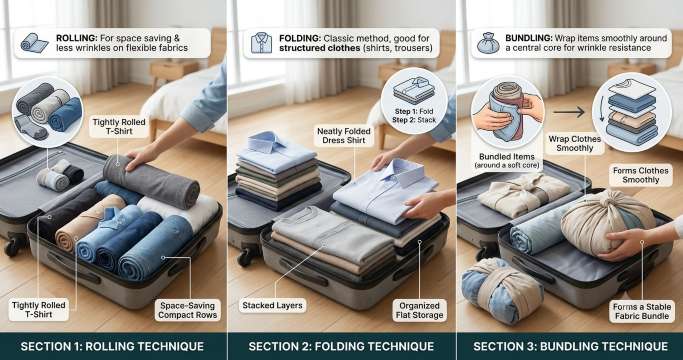
Frequent flyers often debate whether to roll or fold clothes. The key to packing your bag correctly is a hybrid approach to optimise space usage and prevent wrinkles.
So, let's look at each technique.
The Roll Method (Apt for Casual and Knitwear)
- Rolling clothing tightly help use space efficiently, while also eliminating air pockets. It also simplifies viewing items at a glance while opening the bag.
- Some outfits you can roll well include t-shirts, jeans, shorts, synthetic athletic wear, underwear, and synthetic sweaters.
- However, before rolling clothes in a tight cylinder, you must smooth out wrinkles with your hands.
The Fold Method (Suited for Structured Garments)
- Structured clothing includes linen garments, dress shirts, blazers, tailored trousers and evening outfits. These must be folded carefully to avoid damage.
- Avoid rolling these items as rolling them creates persistent deep creases along stiff seams.
- Even while folding, use a tissue paper or thin plastic cleaning bags between folds to minimise friction and creasing.
The Ranger Roll and Bundle Packing
- Ranger Roll involves tucking bottom hems back over the rolled garment to lock it into a tight, self-contained cylinder. It is an extreme space-saving technique.
- On the other hand, for wrinkle-prone suits and dresses, the Bundle Packing method wraps clothes tightly around a central core, creating wide-radius curves instead of sharp fold lines.
How to Load Your Suitcase: Step-by-Step Process
Note: AI-generated image. Only for reference.
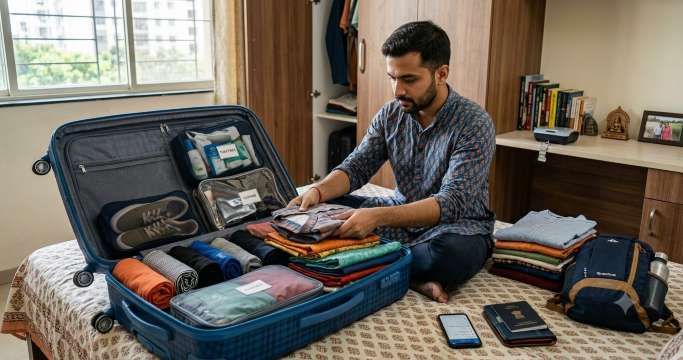
Here's a step-by-step guide or process to help you pack your bag optimally.
Step 1: Heavy Foundation
- Pack your heaviest items, including shoes, toiletries, hairdryer, heavy boots and books at the hinge end near the wheels of upright suitcases.
- This logical strategy will help prevent heavier items from sliding down and damaging delicate clothing when the suitcase stands vertically.
- Fill shoe interiors with rolled socks to conserve space and also help shoes hold their shape.
Step 2: Middle Core Layer
- Fill this space with your rolled jeans, t-shirts, and compression cubes (fabric travel organisers with a dual-zipper system to squeeze excess air out of your clothes and reduce their overall volume) consisting of sweaters and casual trousers.
- An arrangement like this helps create a shock-absorbing cushion.
Step 3: Upper Top Layer
- This is where you must place neatly folded shirts, suits, dresses and delicate fabrics on the top surface.
- Since they are the top of everything, they face minimal downward pressure, ensuring them stay fresh and wrinkle-free.
Step 4: Perimeter Gaps and Accessories
You can also use gaps and empty spaces smartly by placing small accessories, belts, swimsuits, adapters and scarves.

Zhangjiajie National Forest Park
4.6/5
8817 reviewsZhangjiajie is definitely a place worth visiting. Describing its beauty is pointless. You just have to see it.

N Seoul Tower
4.6/5
3419 reviewsA very beautiful place worth visiting. Excellent views of the city from various angles, and in my opinion, it's best to go on a clear day.

Jeju Island
4.7/5
16 reviewsAqua Planet Jeju is said to be one of the largest aquariums in South Korea and one of the top ten in the world.
The main tank, "The Sea of Jeju," is visually stunning. We lingered there for a long time, and the music playing in the hall brought a sense of peace and awe for nature.
Nearby are Seongsan Ilchulbong Peak and Seopjikoji, which can be included in the same itinerary.

Chocolate Hills
4.6/5
71 reviewsIt was certainly a strange landscape with countless hills, but honestly, it felt more ordinary than I expected.
The photos in guidebooks and other publications are taken from above using drones, so you can only see a portion of it from a low vantage point from the actual observation deck.
If you want to enjoy such a distinctive landscape, I personally recommend Osmeña Peak over the Chocolate Hills.

Grand World Phu Quoc
4.5/5
325 reviewsGrand World Phú Quốc, gece hayatı ve gösterilerle canlı bir şehir gibi. Gondol, müzik, lezzetli sokak yemekleri ve ışık şovlarıyla romantik eğlenceli.
Packing Toiletries, Liquids and Personal Care Items
Note: AI-generated image. Only for reference.
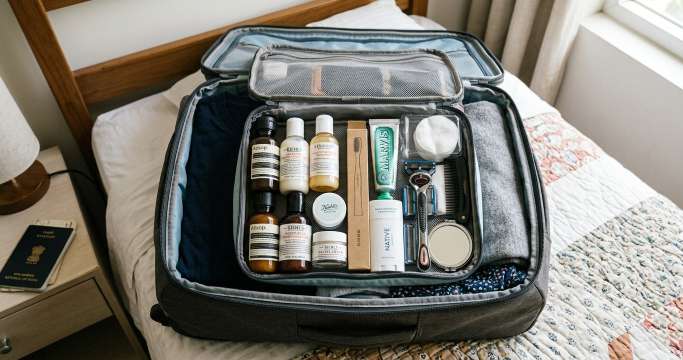
Toiletries can create two concerns, weight and leaks.
Hence, where possible, use travel-sized containers to store shampoo, skincare products and conditioners.
Keep your liquid containers in a sealed toiletry bag instead of placing it among your clothes.
While carrying cabin luggage, liquid, aerosols and gels are subject to security restrictions.
In many countries, carry-on liquid containers have a specific limit. They are usually carried in a transparent resealable bag. Yet, security rules can vary. Hence, you must check the specific rules and regulations of a particular country before packing your bag.
Essential Items, Valuables, and International Travel Preparations
Note: AI-generated image. Only for reference.
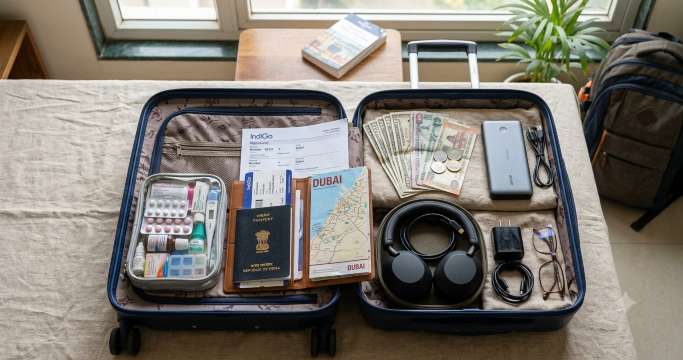
Avoid placing irreplaceable items or critical supplies in checked luggage. That's because your baggage might be occasionally delayed or lost during airport transfers.
Hence, always keep the below in your personal items or carry-on.
- Prescription Medications and Medical Devices: Medications in their original labelled bottles, along with extra supplies for at least 3–4 extra days.
- Power Banks: Power banks with lithium-ion batteries are prohibited in checked luggage. Pack them in your carry-on with easily accessible cords. However, check your airline's specific rules and regulations concerning electronic items.
- Documents and Currency: Passports, visas, driver's licenses, insurance cards, and foreign currency.
- Change of Clothes Outfit: One lightweight change of clothes to deal with baggage delays.
Don't Assume! Weigh Your Suitcase at Home
Note: AI-generated image. Only for reference.
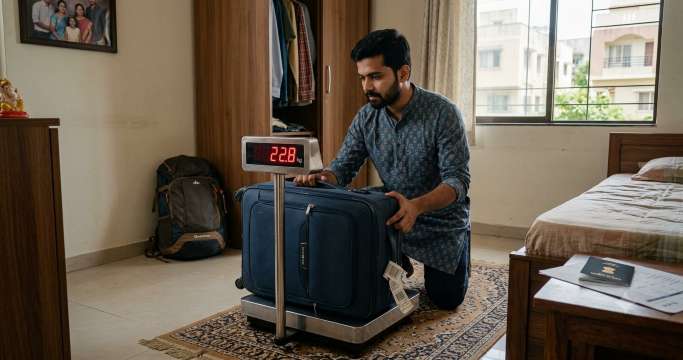
Very important. Usually, travellers lift their bag and guess the weight. Essentially, it means waiting until you reach the airport and potentially discovering that your suitcase is overweight.
You can avoid this. Instead of assuming the weight, use a luggage scale at home.
Once you finalise each item and pack the bag, weigh your bag carefully on the scale.
Compare the result against your airline's allowance. Avoid packing the bag right up to the limit. Leave some margin.
If you notice your bag is heavier than the airline's allowance, look at the densest items first. Assess their need. If you don't need it, you may want to remove it or transfer it another bag. However, don't blindly transfer excess items in the other bag. Check the airline's baggage allowance first and decide.
In a Nutshell: The Simple Formula to Packing a Suitcase Easily
Note: AI-generated image. Only for reference.
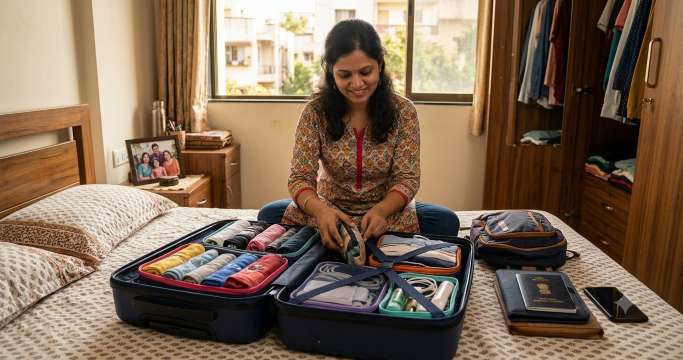
Here's a pretty straightforward summary of how to pack a suitcase for your next trip.
- Plan what you need.
- Edit out unnecessary items.
- Roll soft clothes.
- Fold structured garments.
- Organise categories using packing cubes.
- Distribute heavy items near the wheels.
- Weigh the suitcase at home.
- Finally, check the airline's current baggage and security rules.
The best-packed suitcase isn't necessarily the one that holds the highest number of items. It is the one that stores what you really need, remains within the airline's baggage limits and lets you find what you need easily without unpacking everything.
🔥[Discount] Global Hotel Recommendations
Find Best Global Hotels
See All Hotels







Commonly Asked Questions About Packing a Suitcase
-
Rolling vs. folding clothes, what is better while packing a suitcase?
-
What should I keep in my carry-on bag?
-
How to avoid paying extra for overweight baggage at the airport?
-
How to prevent my clothes from smelling stale during long international flights?
Disclaimer: This article has been provided by an individual contributor or third party platform. If there is any discrepancy regarding the copyright, please contact us directly and we will delete the content immediately.
Trending Searches
-
Popular Airlines
-
Popular Cities