How to Book Multi City Flights Cheaply

By Bethy
October 8, 2026

How to book multi-city flights on Trip.com, plan a route without backtracking, find the cheapest combinations and know when to book. Plus layover and baggage rules.
See all flights


What Are Multi-City Flights?
A multi-city flight is a booking with two or more flight segments that is not a simple there-and-back. The format matters, because the pricing and the protections differ.
Multi-city flights let you fly into one city, travel overland or by air to others, and fly home from somewhere else entirely, without ever retracing your steps. They are also the booking type most likely to go wrong, because a multi-city itinerary is really several flights held together by fare rules, baggage allowances and connection protections that change depending on whether the legs sit on one ticket or several.
Type | What it looks like | Why people book it |
|---|---|---|
Standard multi-city | London to Dubai, Dubai to Bangkok, Bangkok to London | Three cities in one booking, one reference |
Destination open-jaw | Fly into Rome, travel overland to Florence, fly home from Milan | Removes a pointless backtracking flight |
Origin open-jaw | Fly out of one home airport, return into a different one | Uses whichever airports were cheapest each way |
Double open-jaw | Different origin and destination airports on both ends | Common on long-haul trips stitched around LCC routes |
Stopover itinerary | A long planned stop at a hub, usually over 24 hours | Turns a connection into a second destination |
Two terms get used loosely and cause real confusion:
- A layover is a connection on the way to somewhere else, generally under 24 hours internationally. You stay in the airport or nearby, and the airline treats the whole thing as one journey.
- A stopover is a deliberate break of 24 hours or more. On a single ticket, some carriers offer these free or at low cost; on separate tickets, stopping anywhere is simply the end of one booking and the start of another.
- An open jaw is where the gap between arrival and departure is covered by ground transport rather than a flight. It is a type of multi-city trip, not a separate product.
How to Book Multi-City Flights on Trip.com
On Trip.com, switch the flights search from Round-trip to Multi-city, add your legs (up to six segments), then check the fare rules and baggage for each leg before you pay. Book multi-city earlier than you would a round trip, because availability across several flights runs out faster than on a simple A-to-B ticket.
The flow is short. The decisions inside it are where the money and the risk sit.
- Open the Trip.com app or site and go to Flights.
- Change the trip type from Round-trip or One-way to Multi-city.

- Enter the departure city, destination and date for the first leg.
- Fill in the second leg, then use Add another flight to keep going. Trip.com accepts up to six segments in one multi-city search.
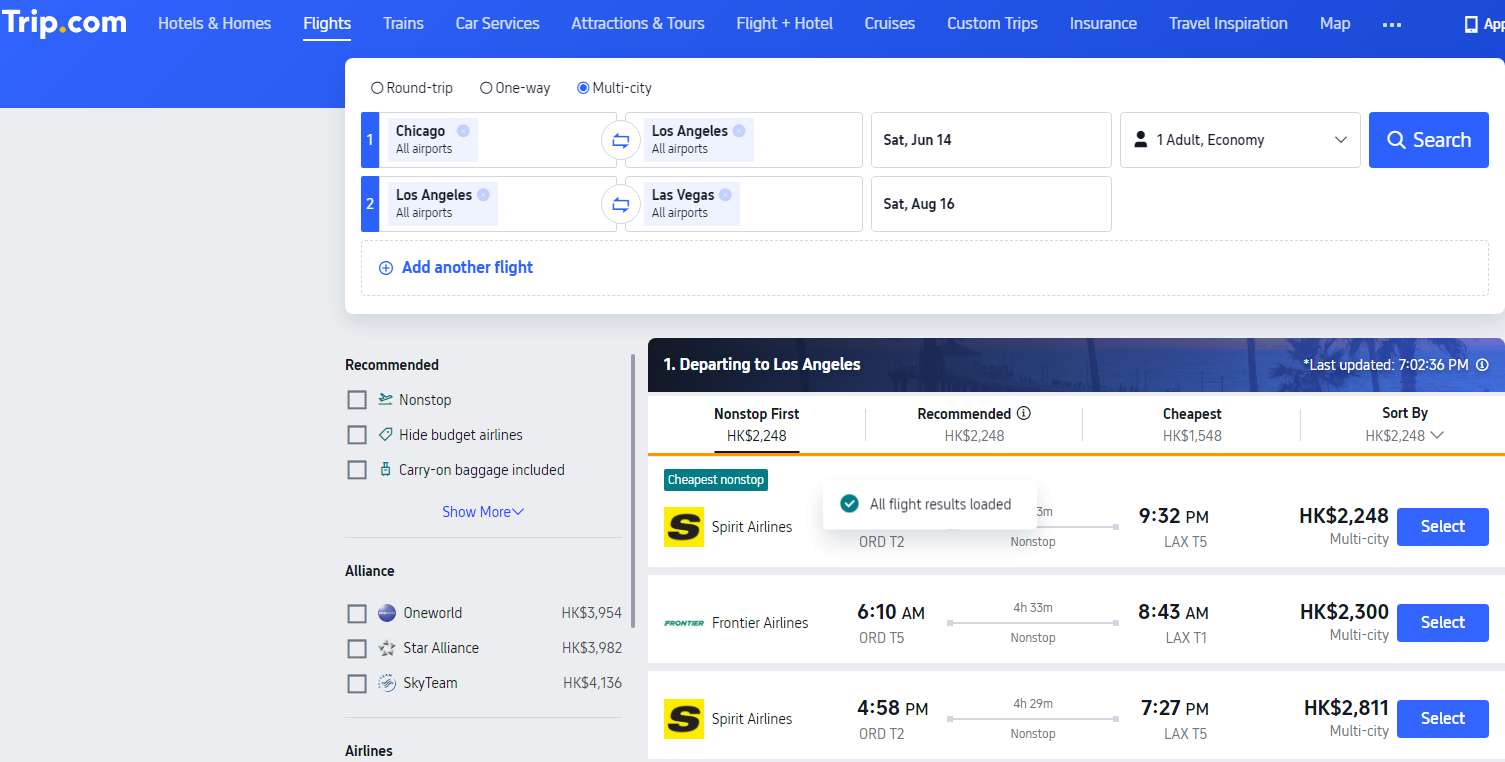
- Set the number of passengers and your cabin. These apply across the itinerary, so if you want a different cabin on one leg, that usually means booking that leg separately.
- Search, then sort and filter by price, total duration, departure time or airline.
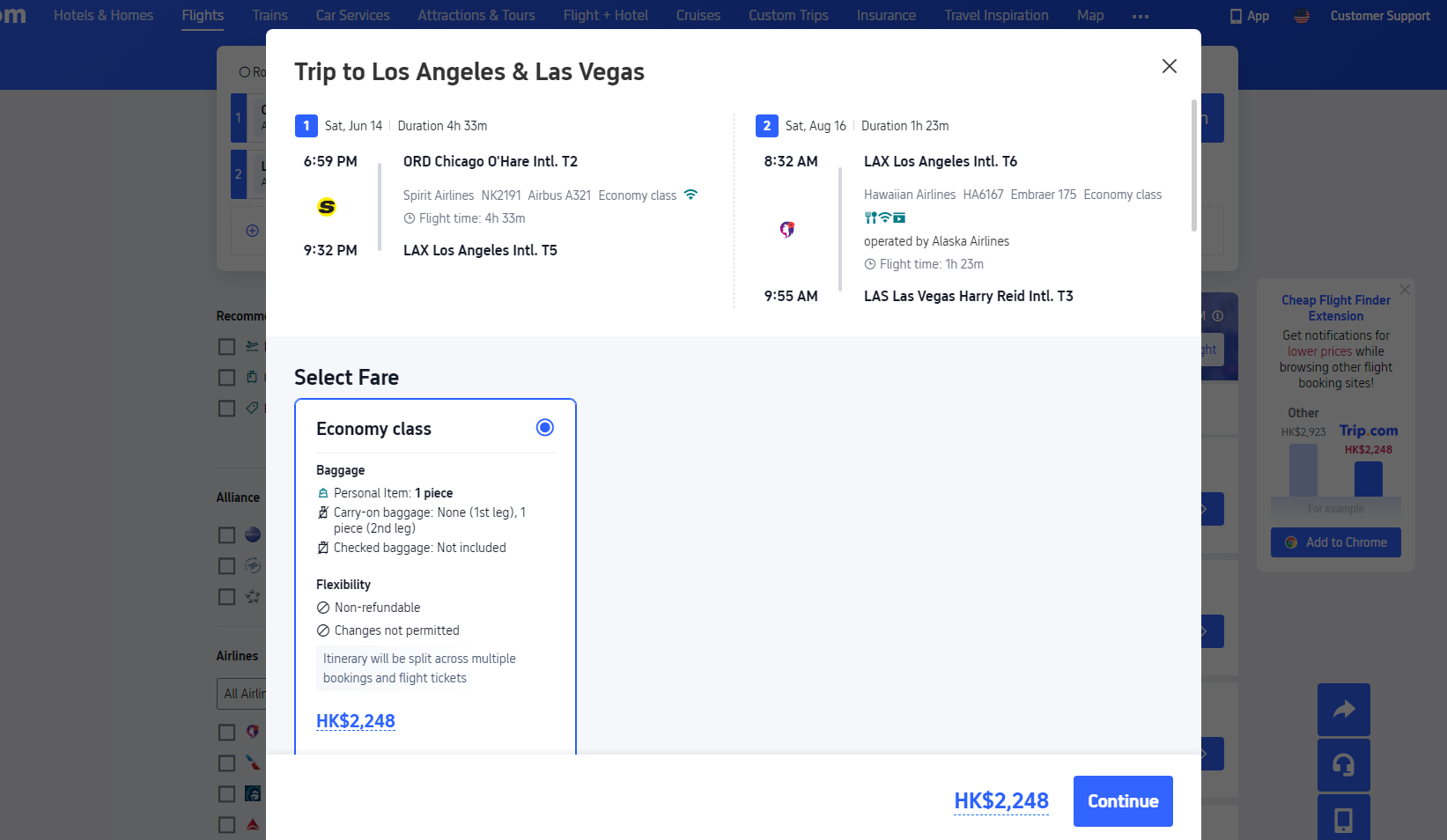
- Before you pay, open the details for every leg. Check the layover duration, the fare rules and the baggage allowance separately, because they can differ from leg to leg on a mixed-airline itinerary.
- Enter passenger details, add any seats or bags, and pay. You receive one itinerary with one booking reference.
If your trip needs more than six legs, add the extra flights as separate bookings. That works, but it changes the nature of the trip: those extra legs become their own contracts with no connection protection, which the self-transfer section below covers.
One habit worth building: read the label on each option before you fall in love with the price. Trip.com flags itineraries that involve separate tickets, and the cheapest result on the page is often the one carrying that label.
How to Plan a Multi-City Route That Doesn't Waste Money

Credit: Unsplash, Hanson Lu
Route order changes the price more than most people expect, and it is free to fix before you book.
- Map the geography first. Draw the cities and put them in an order that never doubles back. A route that goes north, south, then north again is paying for a flight you did not want.
- Use ground transport for the middle. The classic open jaw is a flight into one city, a train or bus across, and a flight out of the next one. This works best where rail is fast and cheap, such as Japan, Western Europe or China's high-speed network.
- Test the direction both ways. Departure taxes and airport charges differ by country, and long-haul departure taxes in some markets push the total up noticeably. Flying A-to-B then C-to-A can price very differently from A-to-C then B-to-A.
- Check nearby airports. A different arrival airport in the same metro area sometimes removes an expensive leg entirely. The trade-off is the transfer cost and time, so count both.
- Look for carrier stopover programmes. Several airlines sell long stopovers at their hub for little or nothing, which effectively adds a city to your trip for the price of the connection. Icelandair, TAP Air Portugal, Turkish Airlines and Qatar Airways all run versions of this.
- Keep the trip's edges simple. Put the most complex, tightest connections at the start, when you still have energy and schedule slack, and leave the last leg generous so a delay does not cost you the flight home.
How to Find the Cheapest Multi-City Flights
There is no single cheapest way to fly multi-city, because the answer depends on whether your route is served by full-service carriers or budget airlines. The work is comparing four structures.
Structure | Usually cheapest when | What you give up |
|---|---|---|
One multi-city ticket | Long-haul, legacy carriers, alliance routes | Flexibility, and some carriers restrict changes |
Two separate round trips | Your trip naturally splits into two there-and-back trips | Time, and the two halves are unrelated |
Separate one-way tickets | Short-haul routes dominated by budget airlines | Connection protection disappears |
Open-jaw plus ground transport | Rail or bus links the middle cities | Ground travel time and baggage hauling |
Four tactics that reliably move the price:
- Compare the one-ticket price against the sum of the one-ways. Full-service carriers often price a standalone long-haul one-way at a large premium over half a round trip, which is exactly why a single multi-city ticket can beat two one-ways on long-haul. On short-haul routes flown by budget carriers, the opposite is usually true, because those airlines price point to point with no round-trip discount.
- Total the real cost, not the headline fare. On low-cost carriers, a cheap fare plus two checked bags plus seat selection often costs more than a full-service ticket that included the bag. Add the baggage line before you compare anything.
- Be flexible on the day, not just the date. Expedia's 2026 air fare data puts Tuesday as the cheapest day to fly domestically and Friday as the cheapest internationally, with Sunday the most expensive either way. The gap is meaningful, and it is larger than the difference between booking on a Tuesday versus a Saturday.
- Skip hidden-city ticketing. Booking a longer itinerary and getting off at the connection can look cheap, but it breaks the fare rules. Your checked bag goes to the final destination, the airline can cancel the rest of your ticket, and repeat offenders lose their accounts and loyalty status. The saving is not worth the failure mode.
See all attractions
 2585 booked






Multi-City vs Separate One-Ways vs a Round Trip
This is the decision most travellers get wrong, and it comes down to one question: are you buying one journey or several?
One multi-city ticket | Separate one-ways | Round trip | |
|---|---|---|---|
Booking reference | One | One per flight | One |
Missed connection | Airline rebooks you under its rules | Your problem and your money | Airline rebooks you |
Checked bags | Usually checked through to the final stop | Collected and re-checked at each stage | Checked through |
Schedule change by the airline | They re-accommodate you | Nobody knows or cares | They re-accommodate you |
Change and cancellation | Rules apply to the whole ticket | Each ticket separately | Rules apply to the ticket |
Price on budget short-haul | Often higher | Usually the cheapest option | Sometimes not sold at all |
The practical rule: if your legs are on partner airlines and price within about 20 per cent of the separate one-ways, take the single ticket, because you are buying protection as well as transport. If the gap is larger and the route is short-haul on budget carriers, take the one-ways and build in generous buffers.
Baggage Rules on Multi-City Itineraries

Credit: Unsplash
Baggage is where multi-city bookings surprise people, because the allowance is not always uniform.
- On a single ticket, each flight's allowance is set by its own fare rules, and mixed-airline itineraries can carry different limits on different legs. At check-in, the strictest limit on the ticket tends to govern what the agent will accept.
- On separate tickets, you pay per ticket and you collect and re-check your bags at every handover. Two tickets means two sets of fees.
- Ask at check-in for your bag tag to show the final airport, not the connection. If it shows the connection, your bags are not checked through, and you will need to collect them.
- If you have a planned stopover of more than 24 hours, you collect your bags anyway, because the journey has ended for the airline.
- On low-cost carriers, add the bag price at the time of booking. Paying at the airport costs more than paying online.
When to Book Multi-City Flights
Booking-window data is directionally useful but differs by market, so treat these as ranges rather than rules. The figures below come from US departure studies, including Expedia's 2026 Air Hacks report, Google Flights and CheapAir.
Trip type | Best booking window | What the data shows |
|---|---|---|
Domestic | 3 to 7 weeks out | Google Flights puts the domestic low around 39 days, with the good window at 23 to 51 days |
International | 1.5 to 3 months out | Expedia found booking 31 to 45 days ahead saved around USD 190 against booking six months early |
Peak season or holidays | 4 to 6 months out | Inventory, not price, becomes the constraint |
Multi-city itineraries | Earlier than the equivalent round trip | You need availability on several flights at once |
That last row is the multi-city-specific point, and it is the one that costs people money. A round trip only has to find two flights that work together. A four-leg multi-city itinerary has to find four, and a single sold-out leg breaks the whole combination. The cheapest multi-city fares cluster in the same windows as ordinary tickets, but the good combinations disappear earlier, so start searching at the early end of the window and book once the price is close to the lows you have seen rather than waiting for a perfect number that may never appear.
One thing not to bother with: hunting for the cheapest day of the week to press the buy button. The measured effect is a couple of per cent at most, while shifting your travel date by a day can move the fare by far more.
How Long Should Your Layovers Be?

Credit: Unsplash, JESHOOTS.COM
Airports publish minimum connecting times, and those are the floor, not the target. On a multi-city trip you should aim well above them.
Situation | Sensible buffer | Why |
|---|---|---|
Same ticket, same terminal, international to international | 1.5 to 2 hours | No bag collection, no border formalities beyond transit |
Same ticket, international arrival then domestic departure | 2.5 to 3 hours | Immigration, baggage claim, re-check, then security again |
Self-transfer, same airport | 3 to 4 hours | You repeat check-in and bag drop, and bag counters close 45 to 60 minutes before departure |
Self-transfer with an airport change in the same city | 4 to 6 hours, or overnight | Traffic alone can eat two hours |
Any connection at a very large or congested hub | Add an hour to the above | Queues are the variable, not the flight time |
Two rules sit above the table. Within one ticket, the airline is responsible for a connection it sold you, so a missed connection should be rebooked at no cost. Across separate tickets, nobody is responsible but you.
Car Rentals
Car Rental Promo Code - 8% Off
New User Enjoy up to 8% Off
TRIPCAR8
Self-Transfer and Separate Tickets: What You Are Actually Booking
This is the part of multi-city travel that generates the complaints, and it is entirely avoidable once you know what you are looking at.
A self-transfer itinerary is one where Trip.com has combined flights from airlines that do not have an interline or codeshare agreement. It may appear as one purchase, but it is two or more tickets with separate booking references. That single fact changes everything downstream:
- Your bags are not checked through. You clear immigration, collect your luggage, and check in again for the next flight.
- If the first flight is delayed and you miss the second, the second airline owes you nothing. You are marked as a no-show, and the ticket is typically void.
- You may need full entry permission for the transit country, not just airside transit, because collecting a bag means leaving the secure area.
- A schedule change on one ticket does not trigger any re-accommodation on the other, so a small time shift can silently create an impossible connection.
Trip.com labels these itineraries so you can see what you are buying, and where a self-transfer protection package is offered, it is attached to the booking rather than automatic. Read the terms shown on your itinerary, because the cover and the caps are set there.
The mechanics matter more than the amounts: you must contact Trip.com first when something goes wrong, rather than buying replacement flights yourself; you must respond to any alternative itinerary within the window stated in the terms; and you must keep itemised receipts for anything you buy with prior authorisation. Cutting out any of those steps is usually what turns a covered disruption into an uncovered one.
Visas and Transit Requirements for Multi-City Trips
Credit: Unsplash, Matthew Smith
A multi-city trip touches more countries than a round trip, which means more immigration rules to check before you book rather than at the gate.
- On a single through ticket, many countries allow airside transit without a visa, provided you stay in the transit area and the connection is short.
- On a self-transfer, you are entering the country in the immigration sense, because you need your bag. Airside transit exemptions do not apply, and you need whatever visa or electronic authorisation that country requires of your passport.
- Some countries require a visa even for a connection if you must change terminals and clear security landside.
- The airline checks your documents at the departure airport and can refuse boarding if you cannot satisfy the transit country's rules, even when your final destination is visa-free for you.
Do the check per transit point, in the order you will travel, and confirm with the airline or the embassy rather than relying on a general rule of thumb.
How to Change or Cancel a Multi-City Booking
On a single ticket, your fare rules apply to the whole booking, so changing one leg can trigger a recalculation of the entire fare, not just a fee on the leg you changed. Cancelling one leg while keeping the rest is often not possible at all, because the fare was constructed on the assumption that all legs are flown in order.
On separate tickets, the legs are independent in exactly the way you would expect: a change to one does not affect the others. The catch is that schedule changes can quietly break the connection between them, and no airline will fix that for you.
Two practical notes. Check the fare rules for every leg before you book, not just the first, since a multi-city ticket takes the most restrictive rules across its flights. And if you are cancelling, do it before the first flight departs, because missing the first leg generally voids the rest of the ticket.
What to Do If You Miss a Connection
The correct action depends on how the connection is held, and getting it wrong is expensive.
Type of connection | Who to contact | What happens |
|---|---|---|
One ticket, airline-caused delay | The airline's transfer desk in the airport | They rebook you, usually at no cost, under their own rules |
One ticket, your delay | The airline, but expect a fee | Rebooking depends on the fare rules and availability |
Self-transfer, airline-caused delay | Trip.com first, before you buy anything | The protection, where you have it, is attached to the booking, not the airline |
Self-transfer, your delay | Nobody owes you anything | You buy a new ticket, and the remainder of that booking is usually void |
If you are on a self-transfer, contact Trip.com before you spend a cent, and keep every receipt. Buying a replacement flight yourself and claiming afterwards is the most common way travellers lose the protection they paid for.
What Trip.com Does to Protect a Multi-City Booking
Multi-city bookings are flight bookings, so the standard flight protections apply, and it is worth knowing what they do and do not cover.
- Flight Price Guarantee. Once payment is confirmed, the price of the booking does not change. If the ticket is not issued after a successful payment because of Trip.com's fault and the fare has risen, Trip.com covers the difference. It is a price lock, not a price match.
- Booking Guarantee. Once tickets are issued, if you cannot board because of Trip.com's fault, Trip.com compensates, with the maximum being a refund of the original ticket plus a replacement flight designated by Trip.com.
- 24/7 support. Customer service is reachable by chat or phone around the clock, which matters most at the exact moment a connection fails.
- Self-transfer labelling and cover. Separate-ticket itineraries are flagged during search and checkout, and protection packages are shown on the itinerary where they apply.
The limits are as important as the cover. A schedule change or an airline cancellation is not covered by the Price Guarantee, bookings made within two hours of departure are excluded, and Ryanair bookings do not qualify for any Trip.com service guarantee. You must also contact Trip.com rather than arranging your own fix, or you forfeit your rights.
🔥[10% OFF] Global Hotel Recommendations
10 Best Global Hotels
See All Hotels







FAQs about Multi-City Flights
-
What is a multi-city flight?
-
How many flights can I add to a Trip.com multi-city booking?
-
Are multi-city flights cheaper than booking one-ways?
-
Will the airline protect me if I miss a connection on a multi-city ticket?
-
How long should a layover be on a multi-city trip?
-
Will my bags be checked through on a multi-city itinerary?
-
Can I change or cancel just one leg of a multi-city booking?
-
Do I need a transit visa for a multi-city trip?
Disclaimer: This article has been provided by an individual contributor or third party platform. If there is any discrepancy regarding the copyright, please contact us directly and we will delete the content immediately.
Trending Searches
-
Popular Airlines
-
Popular Cities